
Running a third-party logistics operation means juggling multiple clients, complex billing structures, tight SLAs, and constant pressure to grow – all at the same time. A generic warehouse management system wasn’t built for that kind of complexity.
What separates a 3PL-specific WMS from standard warehouse software comes down to a few things: multi-client architecture, automated client billing, and customer-facing portals that give your clients real-time visibility into their inventory.
That’s why choosing the right WMS matters so much for 3PLs. The wrong system creates manual work, slows down client onboarding, and turns billing into a weekly headache. The right one becomes the operational backbone that lets you take on new business with confidence.
This article breaks down the five best warehouse management systems built for 3PL providers. Each solution was evaluated on its feature set, scalability, ease of use, and how well it handles the specific demands of multi-client fulfillment.
What to Look for in a 3PL WMS?
Before comparing platforms, it helps to know what separates a strong 3PL WMS from one that just checks the basic boxes. These are the criteria that matter most when you’re managing fulfillment for multiple clients:
- Multi-client inventory management that keeps each client’s stock separate and trackable without manual workarounds
- Automated billing and invoicing tied directly to warehouse activity – receiving, storage, picking, and shipping
- Client-facing visibility portals that give your customers self-service access to inventory levels, order status, and reporting
- Integrations with ecommerce platforms and carriers so you can connect to Shopify, Amazon, FedEx, and others without custom development
- Scalability across warehouses and order volumes as your operation and client base grow
If a WMS doesn’t cover these out of the box, you’ll spend more time building workarounds than running your business.
The 5 Best Warehouse Management Systems for 3PLs
1. Extensiv – Best for Growing and Mid-Market 3PLs
Extensiv was built by people who actually ran 3PL operations, and that shows in every part of the product. It’s frequently cited as the best warehouse management software for multi-client fulfillment, covering the full workflow – from receiving to invoicing – in a single system.
At the center of the platform is the 3PL Warehouse Manager, which handles inventory tracking, order management, and picking and packing automation through SmartScan. But what sets Extensiv apart is everything around that central module.
The Billing Manager automates invoicing based on actual warehouse activity, so you’re not manually calculating storage fees or pick charges at the end of each month. The client portal gives your customers real-time visibility without requiring your team to pull reports on demand. And the Network Manager supports multi-warehouse and even 4PL operations from a single dashboard.
Extensiv connects with over 500 platforms through its Integration Manager, covering most major ecommerce marketplaces, shopping carts, and shipping carriers.
The results back this up. Averitt cut labor costs by 25% after implementing the platform. APS Fulfillment generated $250K in new business within a single quarter – largely because faster onboarding let them say yes to more clients, more quickly.
Pricing starts at roughly $100-$1,000 per month (depending on the size of your business), which puts it well within reach for growing 3PLs looking for the best WMS they can get without the enterprise price tag.
2. ShipHero – Best for Ecommerce-Focused 3PLs with High Order Volumes
ShipHero is an end-to-end WMS that leans heavily into ecommerce fulfillment. If your client base is mostly DTC brands shipping small parcels at high volume, this platform deserves a close look.
Its strongest features include batch picking workflows, real-time rate shopping across carriers, and custom reporting that gives you operational visibility at both the warehouse and client level. Multi-client support is built in, so you can manage separate inventories and billing for each account without toggling between systems.
The trade-off is pricing. ShipHero starts at around $1,995 per month, which is a steeper entry point than most mid-market options. For high-volume operations where carrier rate optimization and picking speed directly affect margins, that investment can pay for itself quickly. For smaller 3PLs still building their client base, it may be more system than what’s needed right now.
3. Deposco – Best for Mid-Market 3PLs Scaling Toward Enterprise
Deposco is a cloud-native platform that uses machine learning to optimize labor allocation and predict demand patterns. It’s aimed at mid-market 3PLs that are growing fast and need a system that scales without becoming a bottleneck.
One standout feature is client onboarding speed – Deposco claims new clients can be set up in as little as two hours. For 3PLs competing on responsiveness, that kind of turnaround is a real advantage. The platform also integrates well with major ecommerce channels, and its site-based pricing model can be more predictable than per-transaction billing as your volumes increase.
The consideration here is implementation complexity. Deposco requires a more involved setup than SMB-focused tools, so if your operation is still small and straightforward, a lighter platform may be a better starting point.
4. Logiwa – Best for High-Volume Fulfillment and B2C/B2B Hybrid 3PLs
Logiwa is a cloud-native WMS built for high-volume fulfillment, with a strong focus on ecommerce at scale. If you’re running both B2C and B2B fulfillment out of the same warehouses, Logiwa’s flexibility is worth considering.
The platform provides real-time inventory syncing across multiple warehouse locations, AI-powered fulfillment optimization, and automated picking and packing workflows. Its integration library is broad, connecting to most of the platforms and carriers that 3PL clients typically work with.
Where Logiwa might be more than you need is in smaller or simpler operations. The platform is designed for volume and complexity, so if you’re running a single warehouse with a handful of clients, you may not get full value from what it offers.
5. Manhattan Active WM – Best for Enterprise 3PLs with Complex, Global Operations
Manhattan Active WM sits at the top of the market as a Tier-1 enterprise WMS. It runs on a microservices cloud architecture and delivers weekly updates with zero upgrade downtime – a model Manhattan calls “continuous delivery.”
The platform integrates transportation management and distributed order management directly into the WMS, which is useful for 3PLs managing complex, multi-leg supply chains. It also supports advanced automation and robotics integration, and currently serves over 1,700 customers across 50 countries.
The trade-off is cost and complexity. Manhattan Active WM carries premium pricing and a more involved implementation process. For large-scale, global 3PL operations, that investment makes sense. For mid-market operators, it’s likely more system than most will need.
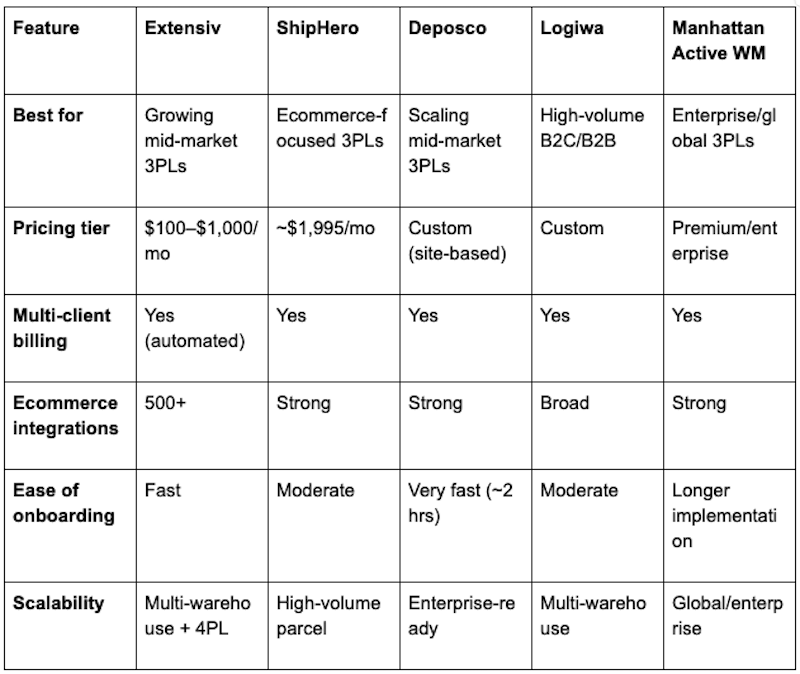
3PL WMS Comparison Table
How to Choose the Right 3PL WMS?
The right WMS depends on where your operation is today and where you’re headed. Here’s a quick framework to match your situation to the best fit.
If you’re a growing mid-market 3PL that needs fast client onboarding and automated billing without a massive upfront investment, Extensiv is the most complete fit at a reasonable price point.
If your clients are mostly DTC ecommerce brands and you’re shipping high volumes of small parcels, ShipHero or Logiwa will give you the fulfillment speed and carrier optimization you need.
If you’re scaling fast and want predictable costs as volume grows, Deposco’s site-based pricing and ML-powered optimization are worth evaluating.
And if you’re running a large enterprise or global operation with complex supply chains and advanced automation requirements, Manhattan Active WM has the depth to match that scale.
In every case, start by mapping your current client mix, order volumes, and growth trajectory. Then match those against the strengths of each platform rather than buying based on feature lists alone.
Wrap Up
Choosing a WMS as a 3PL isn’t the same as choosing one for a single-brand warehouse. You need a system that handles the complexity of multiple clients, automates the billing that would otherwise eat up your team’s time, and scales as you bring on new business without forcing a painful platform migration down the road.
The five platforms here each serve a different segment of the 3PL market well. Your best choice comes down to your size, your client mix, and how fast you plan to grow. If you’re a mid-market 3PL ready to move past spreadsheets and manual processes, starting with a demo from Extensiv is a solid first step.
FAQ
What makes a WMS “3PL-specific” compared to a standard warehouse management system?
A 3PL-specific WMS is built around multi-client architecture from the ground up. That means separate inventory tracking per client, automated billing based on warehouse activity, and customer-facing portals – features that standard warehouse software typically doesn’t include without heavy customization.
How much does a 3PL WMS cost?
Pricing varies widely depending on the platform and your operation’s size. Entry-level 3PL WMS options like Extensiv start at around $599 per month, while platforms like ShipHero start at $1,995 per month. Enterprise solutions like Manhattan Active WM use custom pricing based on scope and deployment complexity.
Can I switch WMS platforms without disrupting my clients?
Yes, but it requires planning. Most modern WMS providers offer migration support and parallel running periods. The key is mapping your current workflows, testing integrations before going live, and communicating timelines clearly with your clients throughout the transition.
How long does it take to implement a 3PL WMS?
It depends on the platform and the complexity of your operation. Some systems like Deposco can onboard individual clients in as little as two hours. Full platform implementation typically ranges from a few weeks for cloud-native tools to several months for enterprise systems like Manhattan Active WM.
Do I need a 3PL-specific WMS if I only have a few clients?
Even with a small client base, a 3PL-specific WMS saves time on billing, keeps inventory organized by client, and makes onboarding new accounts faster. If you plan to grow, starting with the right system early avoids a painful migration later.
