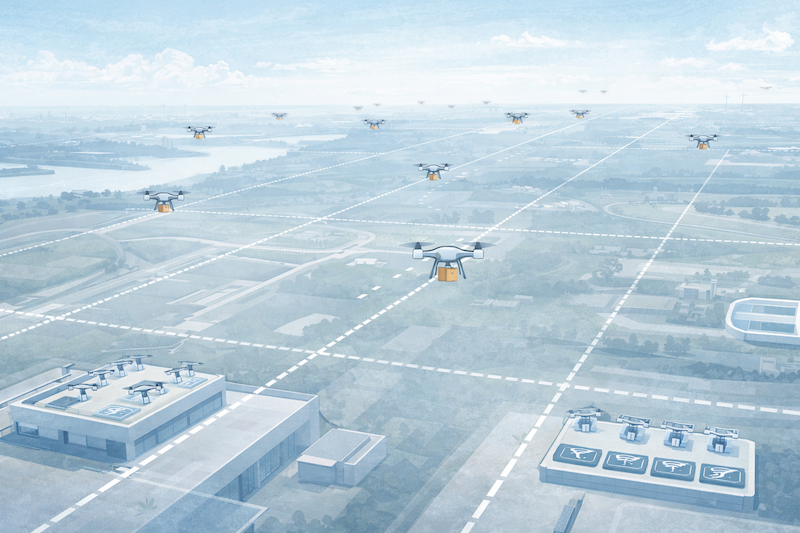
Robotics & Automation News has released a new premium industry report examining the operational realities, economic constraints, and long-term outlook for drone delivery systems.
Titled Drone Logistics: Infrastructure, Economics and Market Outlook (2026-2032), the Trend Analysis provides a structured assessment of a sector that has moved beyond early-stage experimentation and is entering a more commercially disciplined phase.
While drone delivery has often been framed as a disruptive force in last-mile logistics, the report concludes that the technology is more likely to develop as a specialised layer within broader distribution networks rather than a universal replacement for ground transport.
Drawing on market data, vendor activity, regulatory developments, and deployment case studies, the analysis separates demonstrated capability from industry expectation and evaluates where sustainable service models are beginning to emerge.
The report identifies a number of structural forces shaping the next stage of the market, including the shift from pilot programmes to repeatable operations, increasing regulatory clarity in select regions, and growing pressure to demonstrate viable unit economics.
It also highlights the operational environments where drone logistics is already proving effective – such as time-critical deliveries, geographically constrained routes, and locations where traditional infrastructure presents limitations.
At the same time, the study examines persistent barriers to large-scale adoption, including infrastructure requirements, airspace integration, service density thresholds, and cost competitiveness against established delivery methods.
Rather than presenting a single trajectory for the sector, the Trend Analysis explores how drone delivery is fragmenting into distinct commercial pathways, each defined by different economic conditions and deployment constraints.
The report is designed to support decision-makers across logistics, robotics, retail, healthcare, and supply chain strategy who require a grounded understanding of how aerial delivery is likely to integrate into modern distribution architectures over the remainder of the decade.
Key areas covered in the report include:
- Market transition from innovation-driven pilots to operational deployment
- Economic realities of last-mile aerial delivery
- Regulatory progress and airspace considerations
- Vendor landscape and competitive dynamics
- Infrastructure and integration challenges
- Use-case viability across industries
- Outlook for the drone logistics sector through 2030
The publication forms part of the Robotics & Automation News Trend Analysis series, which provides structured, long-form intelligence on major technology shifts affecting industrial automation and global supply chains.
Drone Logistics: Infrastructure, Economics and Market Outlook (2026-2032) is available now via the Robotics & Automation News website.
