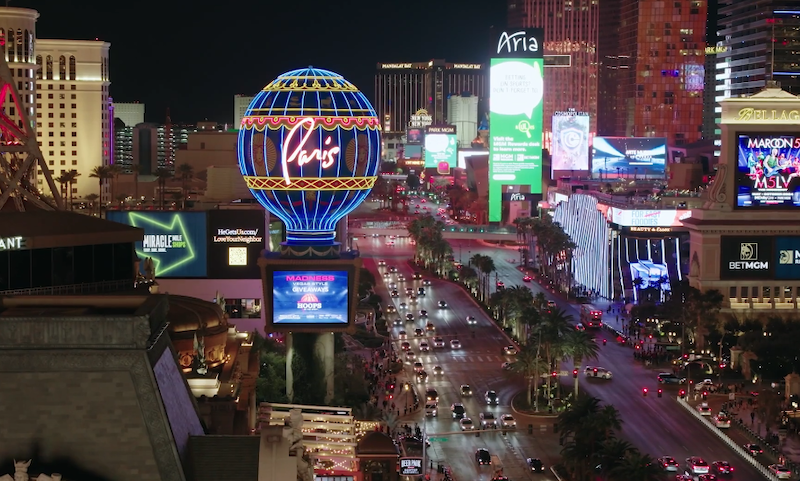
While many cities are still piloting autonomous transport in tightly controlled environments, Las Vegas is moving more aggressively – positioning itself as one of the most visible real-world laboratories for next-generation mobility in the United States.
Across the Strip and beyond, robotaxis, remotely operated vehicles, automated shuttles, and tunnel-based transport systems are shifting autonomy from experimental deployments toward everyday infrastructure capable of moving residents, workers, and tourists.
Taken together, these initiatives suggest a coordinated – if not formally centralized – push toward embedding intelligent transport directly into the city’s operational fabric. If there is a central co-ordinating organization, it’s probably the Clark County Office of Community and Economic Development, Nevada, home of the Las Vegas Strip.
Robotaxis enter public service
Perhaps the most high-profile development is the launch of a public robotaxi service by Zoox, the autonomous vehicle company owned by Amazon.
The company says its purpose-built vehicle is “not a car – it’s a robotaxi designed around you”, combining AI and precision engineering to deliver “a safe and comfortable journey.”
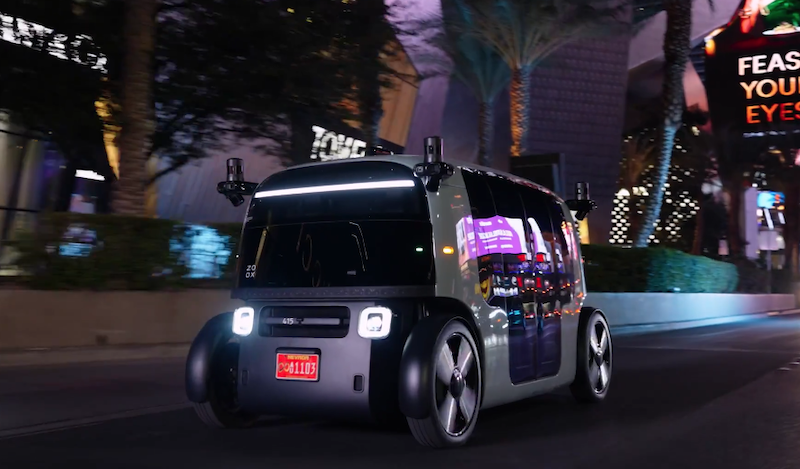
Operating on the Las Vegas Strip, the service allows riders to travel between major attractions in a vehicle developed specifically for autonomous ride-hailing rather than adapted from a conventional car platform.
Zoox says it has tested the vehicles extensively “on the Strip, side streets, and intersections in Las Vegas”, underscoring the city’s willingness to allow autonomous systems into complex urban environments rather than limiting them to geofenced business parks.
The launch is significant because it represents one of the clearest examples yet of robotaxis transitioning from pilot programs into consumer-facing services.
Teledriving creates a hybrid autonomy model
Not all innovation in Las Vegas is fully driverless. Berlin-founded Vay is introducing what it describes as a new mobility category: remotely delivered rental cars.
Users request an electric vehicle through an app, and a remote driver brings the car to them. After the trip, the vehicle can either be parked by the customer or handed back to a remote operator.
The company positions the model as a cost-efficient alternative to ride-hailing, promising rentals “at half the price of ride-hail”.
Vay says remote driving enables driverless services today while helping build “a safe, flexible foundation for the autonomous mobility of tomorrow”.
Industry observers increasingly view teledriving as a pragmatic bridge technology – one that sidesteps some regulatory barriers while allowing operators to scale services before full autonomy is widely approved.
Automated shuttles target healthcare mobility
Beyond tourism and consumer travel, autonomy is also being applied to essential services.
The Regional Transportation Commission of Southern Nevada is leading the GoMed program, deploying automated shuttles to connect a downtown transit hub with the Las Vegas Medical District.
Designed as one of the first deployments of autonomous shuttles within regular transit service, the system will operate in mixed traffic and integrate with travel apps and traffic signals.
Covering a 674-acre cluster of hospitals, clinics, and medical facilities, the network aims to provide an accessible transport option for patients, staff, and students while demonstrating a model that could be replicated city-wide.
Safety is central to the design, with advanced pedestrian detection intended to protect both passengers and surrounding road users.
Healthcare mobility is widely seen as an attractive early use case for autonomous vehicles because routes are predictable and the value of reliable transport is high.
Tunnel transport scales toward mass capacity
Meanwhile, underground infrastructure is expanding rapidly through the Vegas Loop developed by The Boring Company, the tunneling venture founded by Elon Musk.
The system has already transported more than 3 million passengers across eight stations.
In its planned final form, the network will include 68 miles of tunnels and 104 stations, with projected capacity of up to 90,000 passengers per hour and transit times between two and eight minutes.
Key destinations are expected to include Harry Reid International Airport, Allegiant Stadium, and downtown Las Vegas.
Some tunnels are already operational while others remain under construction, reflecting a phased approach to building what local authorities view as long-term mobility infrastructure.
If completed at scale, the Loop could represent one of the most ambitious integrations of automated transport into an urban environment.
Orchestrating the ‘physical AI’ ecosystem
As autonomous machines multiply across land, air, and potentially other domains, coordination is emerging as a critical challenge.
Las Vegas startup Terbine is developing Strata, an AI-enabled mobility infrastructure platform designed to synchronize intelligent machines with each other and their operating environments.
The company says the platform will provide “realtime orchestration and synchronization” for electric vehicles, drones, delivery robots, and other automated systems.
Such platforms could become increasingly important as cities transition from isolated pilots to dense networks of autonomous machines competing for space, connectivity, and energy resources.
Why Las Vegas is moving faster
Several factors appear to be accelerating adoption in the Nevada city.
Unlike older metropolitan areas constrained by legacy transit systems, Las Vegas has historically embraced large-scale infrastructure experimentation. Its tourism-driven economy also creates strong incentives to improve transport efficiency while delivering novel visitor experiences.
Regulatory openness has played a role as well, enabling companies to test technologies in live urban conditions.
For autonomous mobility providers, the city offers something increasingly rare: a proving ground where commercial deployment is not years away but already under way.
A preview of the autonomous city?
Individually, each project represents a meaningful step forward. Collectively, they suggest a broader shift – from autonomy as a research objective to autonomy as a functioning layer of urban infrastructure.
Robotaxis are carrying passengers. Remote drivers are delivering cars. Automated shuttles are connecting medical facilities. Tunnel networks are expanding beneath the city.
The result is less a single breakthrough than a gradual normalization of machine-driven transport.
Whether Las Vegas ultimately becomes a template for other US cities remains uncertain. Questions around safety, regulation, public acceptance, and long-term economics still shape the trajectory of autonomous vehicles nationwide.
But one conclusion is increasingly difficult to ignore: autonomy is no longer confined to controlled pilots; in Las Vegas, it is beginning to look like everyday mobility.
