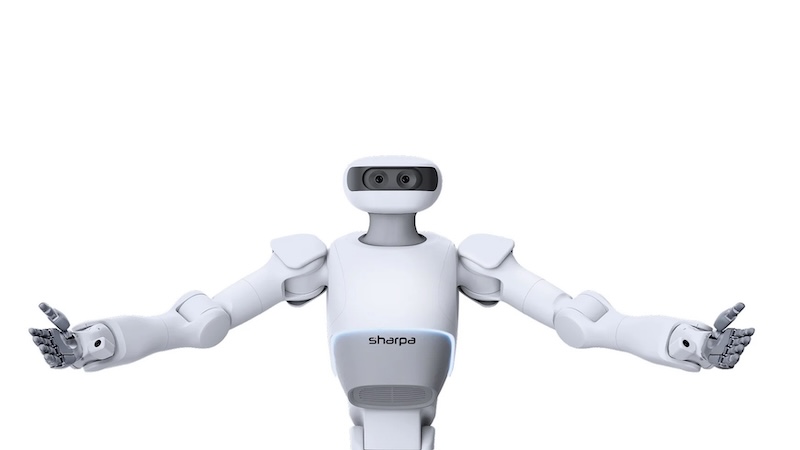
Robotics startup Sharpa used live demonstrations at CES 2026 to showcase advances in autonomous fine manipulation, unveiling a new full-body robot and an AI model designed to improve how robots interact with objects.
At the event in Las Vegas, Sharpa’s newly introduced robot, North, played fully autonomous games of ping-pong against human opponents throughout the show.
Rather than relying on pre-scripted demonstrations, the company ran live sessions for eight hours a day over four consecutive days, drawing large crowds as the rallies continued.
Sharpa said the demonstrations were intended to highlight progress in real-world manipulation rather than staged motion or acrobatics.
Live demonstrations highlight long-horizon autonomy
In addition to ping-pong, North performed a series of autonomous tasks including photography, windmill assembly, and card dealing.
According to the company, the windmill assembly task required more than 30 consecutive successful steps, making it one of the longest-horizon autonomous manipulation demonstrations shown publicly to date.
Across the event, North captured more than 2,000 instant photographs and assembled more than 300 windmills. The demonstrations circulated widely on social media and attracted attention from robotics developers and researchers.
Sharpa expects to release a production version of North in mid-2026.
Dexterous hand enters production
The CES demonstrations were powered by Wave, a dexterous robotic hand introduced by Sharpa in May 2025. Wave features 22 active degrees of freedom, is built at a one-to-one human scale, and includes a proprietary tactile sensing system. The company said the hand entered mass production and began shipping in October 2025.
Alicia Veneziani, Sharpa’s global vice president of go-to-market and president of Europe, said: “Robots can already dance and backflip, but manipulation remains the real bottleneck for useful, autonomous robots. At Sharpa, we focus on productivity from day one, which is why we started with the hardest part, the hand.”
Introducing CraftNet for fine manipulation
Alongside the hardware demonstrations, Sharpa introduced CraftNet, an end-to-end hierarchical VTLA (vision–tactile–language–action) model designed to support fine manipulation tasks.
CraftNet is built on Sharpa’s multi-system manipulation architecture, which the company says is inspired by how humans combine reflexive responses with higher-level reasoning.
The system separates control into two layers: an “Interaction Brain” for contact-level responses and a “Motion Brain” for coordinated movement, with a focus on what Sharpa describes as “last-millimeter” precision.
The company said it will release updates on CraftNet in phases.
Focus on practical deployment
Sharpa positions its work around the idea that improving fine manipulation is key to moving robots from demonstrations into everyday use.
The company sees potential applications across sectors including retail, hospitality, and food service, with longer-term ambitions for domestic environments.
Sharpa describes its mission as follows: “We manufacture time by making robots useful.”
The company was co-founded by Shaoqing Xiang, David Li, and Kai Sun, and employs more than 100 people globally. Sharpa was founded in 2024 and is headquartered in Singapore, with business operations in the United States and manufacturing and R&D facilities in China.
