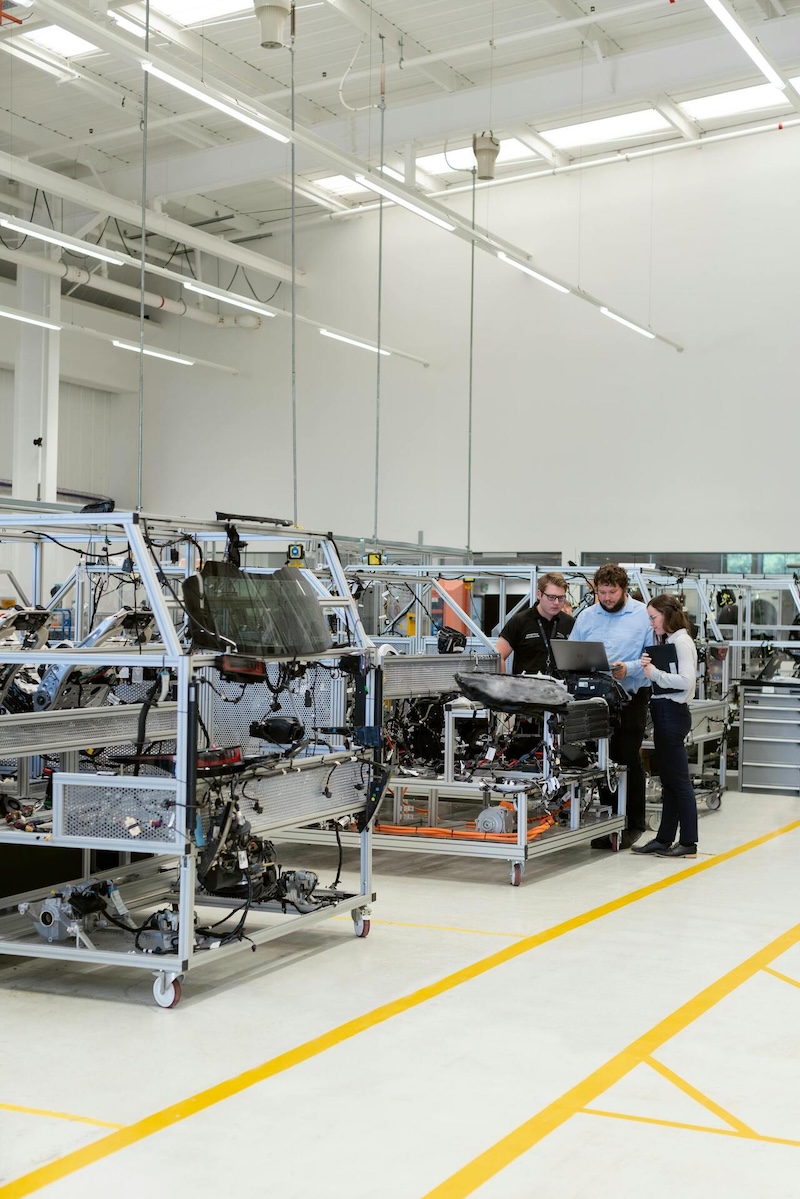
Ten years ago, industrial automation was all about pre-programmed movements. Today, it’s capable of much more dynamic and intelligent processes that are less rigid. Core to this has been the integration of advanced vision systems.
This change kicked off while 2D vision was still the dominant form of guidance, but moving to 3D guidance has seen another wave of innovation in manufacturing.
Perceiving depth and spatial orientation has lifted the ceiling on the complexity of tasks robots can handle, but it’s also lifted the floor in how precise and reliable they are too, which is arguably more important.
Precision with six degrees of freedom
3D guidance means robots can track objects in space with six degrees of freedom (6DoF). So, not only the X, Y, and Z coordinates but also the roll, pitch and yaw of a component.
Automotive assembly is a classic example of precise engineering, and 6DoF means more detail can be picked up, like aligning a component with its housing (even if the component or housing is varied on the assembly line).
It opens the door for computer vision and AI to take more control and make more intelligent judgements, like a human might.
This spatial awareness can even compensate for small environmental variables like thermal expansion or structural vibrations – things that used to derail a high-precision assembly.
Manufacturing flexibility
More traditionally, manufacturing robots would lean heavily on mechanical fixtures and jigs to keep parts in the exact same spot. They were expensive to design and replace.
3D guidance gets rid of a lot of this overhead by allowing robots to adapt to random part positioning. Systems can be set-up with fixed cameras, for example, to scan the work area and adjust its movement.
Eines Solutions is a good example of how these custom-made systems are supplied – and their rampant demand. This move from mechanical jigs to vision systems is what turned the factory floor into a software-defined environment.
The battle is now fought on software – this is where scale is facilitated and where product changes are managed. One update might alter the behavior of an entire fleet of robots. Having fewer physical constraints is of course a mandate for agility.
Improving cycle times
These software updates and improvements, of course, means on-the-fly adjustments can be made, and this ultimately leads to faster cycle, which is a core KPI.
Instead of a robot stopping to wait for a sensor to confirm a given position, advanced algorithms process all the spatial data instantly, and this keeps the movement flowing.
This is super useful in sealing applications, engine assembly, and EV battery placement, where precision needs to be maintained without sacrificing speed.
Besides just the throughput benefits, the high-resolution data captured during these movements is actually a predictive diagnostic tool, and the more it’s used, the more data collected, the more accurate the predictions.
This is, in a truly unique sense, capital-building, in that the robots become more valuable over time, helping offset their physical depreciation.
It can also turn manufacturing companies into consultants and offer other services as they become experts in identifying assembly failures before they occur.
This is the first real opportunity not just for truly autonomous assembly, by autonomous quality control.
