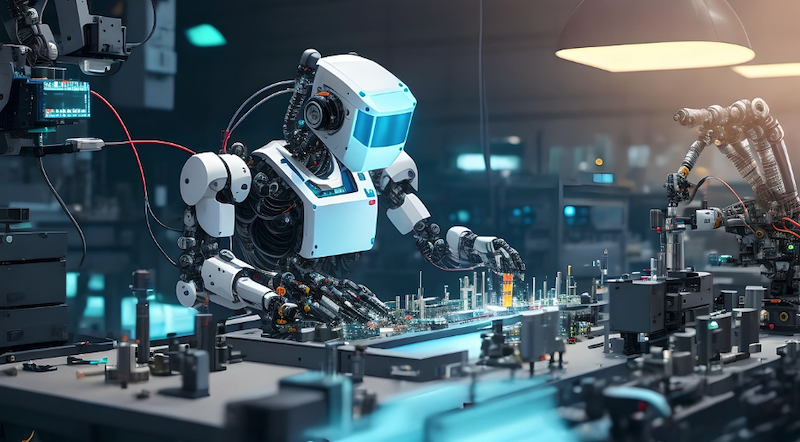
Robots may appear simple from the outside, but internally, they are complex integrated systems composed of multiple elements that work together.
At the most basic level, every robot functions through a combination of the 5 key components: power supply, sensors, control unit, actuators, and end effectors.
In this blog, we will explore the 5 key components of a general robot and understand how they work.
What Are the 5 Basic Components of a Robot
Before exploring the technical details, let’s take a quick overview of the five core elements that make a robot functional:
- Power System: The energy source that powers all robotic functions, from sensors to actuators.
- Sensors: The “senses” that collect environmental data (position, distance, force) to guide decision-making.
- Control Unit: The “brain” that processes sensor inputs, runs software, and issues commands to other components.
- Actuators: The “muscles” that convert energy into physical motion (e.g., rotating joints, moving wheels).
- End Effectors: The “hands” that interact with the environment to perform specific tasks (e.g., gripping, welding).
1. Power System: The robot’s energy source
The power system is the foundation of any robotic operation. Without a consistent and reliable flow of energy, even the most advanced AI-driven robot is nothing more than a stationary sculpture.
Depending on the application, robots may draw power from several sources, with electricity being the most common in modern industrial settings.
For example, a mobile robot relies on efficient power regulation to extend operating time, while an industrial robot depends on stable power delivery to maintain precision during continuous operation. Key functions of the power system include:
The 3 key functions of the power system include:
- Storing chemical or electrical energy for later use (e.g., batteries).
- Converting raw power into specific voltages required by sensitive electronics.
- Routing power efficiently to sensors, controllers, and high-draw motors.
2. Sensors: The robot’s sensing system
Sensors allow robots to perceive and understand their environment. They collect data about position, movement, temperature, pressure, light, or proximity and convert this information into electrical signals that the robot can process.
Different robots use different combinations of sensors depending on their tasks. For instance, a robotic arm may use position sensors and encoders to ensure precise movement, while an autonomous robot may rely on proximity sensors and vision systems to avoid obstacles.
Sensors are essential for feedback and control, enabling robots to adapt to changing conditions. Common sensor functions include:
- Detecting objects and obstacles
- Measuring speed, position, or force
- Monitoring environmental conditions
3. Control Unit: The robot’s brain
The control unit is the decision-making center of a robot. Often built around microcontrollers or processors, it receives data from sensors, processes that information using control algorithms, and sends commands to actuators.
This component determines how the robot behaves in real time. For example, when a sensor detects an obstacle, the control unit decides whether to stop, slow down, or change direction.
In industrial automation, the control unit ensures precise timing and coordination between multiple movements.
Here’s how it works:
- Interpreting millions of data points from sensors every second.
- Calculating the most efficient path for the robot to move from Point A to Point B.
- Constantly checking for system errors or emergency stop signals.
4. Actuators: The robot’s muscles
Actuators are the components responsible for moving the robot’s structure. They take the electrical, hydraulic, or pneumatic energy provided by the power system and convert it into mechanical force.
In most modern robots, actuators take the form of electric motors – such as servomotors or stepper motors – which offer incredible precision and control.
Consider a pick-and-place robot: the actuators move the “limbs” of the machine into position. When the controller says “move 30 degrees,” the actuator executes that command.
The quality of the actuators directly determines the robot’s payload capacity, speed, and repeatability.
High-end actuators often incorporate gearboxes (like strain wave gears) to increase torque while maintaining a compact size.
In general, actuators work for a robot through the process below:
- Turning joints, wheels, or gears.
- Extending or retracting arms and pistons.
- Moving to exact coordinates repeatedly without drifting.
5. End Effectors: The robot’s interaction tool
End effectors are the components that allow a robot to physically interact with the world. Mounted at the end of a robotic arm or structure, they are designed specifically for the robot’s task.
Common end effectors include grippers for picking and placing objects, welding tools for manufacturing, and suction cups for packaging applications.
Although often mechanical in appearance, end effectors usually contain sensors, actuators, and electronic interfaces that enable precise control and feedback.
The role of end effectors includes:
- Grasping, holding, or manipulating objects
- Performing task-specific actions
- Providing feedback to the control system
Why Work with an Electronic Components Distributor for Sourcing Parts
Building reliable robots requires consistent access to high-quality electronic components. Working with a professional electronic components distributor simplifies sourcing and reduces risk throughout the design and production process.
1. Access to Trusted, Diverse Components
Many distributors, like ICRFQ, offer a wide range of robot-critical components, from sensors and ICs to power supplies and connectors. These products come from trusted brands such as Infineon and Texas Instruments, so you won’t get fake components.
2. Cost-Effective Sourcing Solutions
Distributors leverage bulk purchasing power and industry relationships to negotiate competitive prices, helping startups and enterprises alike reduce procurement costs without compromising quality.
3. Inventory Management and Supply Chain Stability
Distributors maintain large inventories and handle excess stock, ensuring timely delivery even during supply chain disruptions – a key advantage for robotics projects with tight deadlines.
4. Technical Expertise
Reputable distributors provide technical support to help select the right components for specific robotic applications (for example, choosing a power supply for a mobile vs. a stationary robot), reducing design errors and rework.
5. Streamlined Logistics
Distributors handle shipping, documentation, and compliance, freeing robotics companies to focus on innovation rather than administrative tasks.
To Sum Up
Essentially, almost all robots operate through the 5 basic components: power systems, sensors, control units, actuators, and end effectors.
Each component plays a vital role in enabling robots to perceive, decide, and act. Sourcing these components from trusted distributors can help build reliable, long-term performance robotic systems.
As robotics technology continues to develop, the synergy between these key components will only grow deeper, especially coupled with the integration of AI. This enables machines to take on a wider range of human tasks and even surpass human capabilities.
