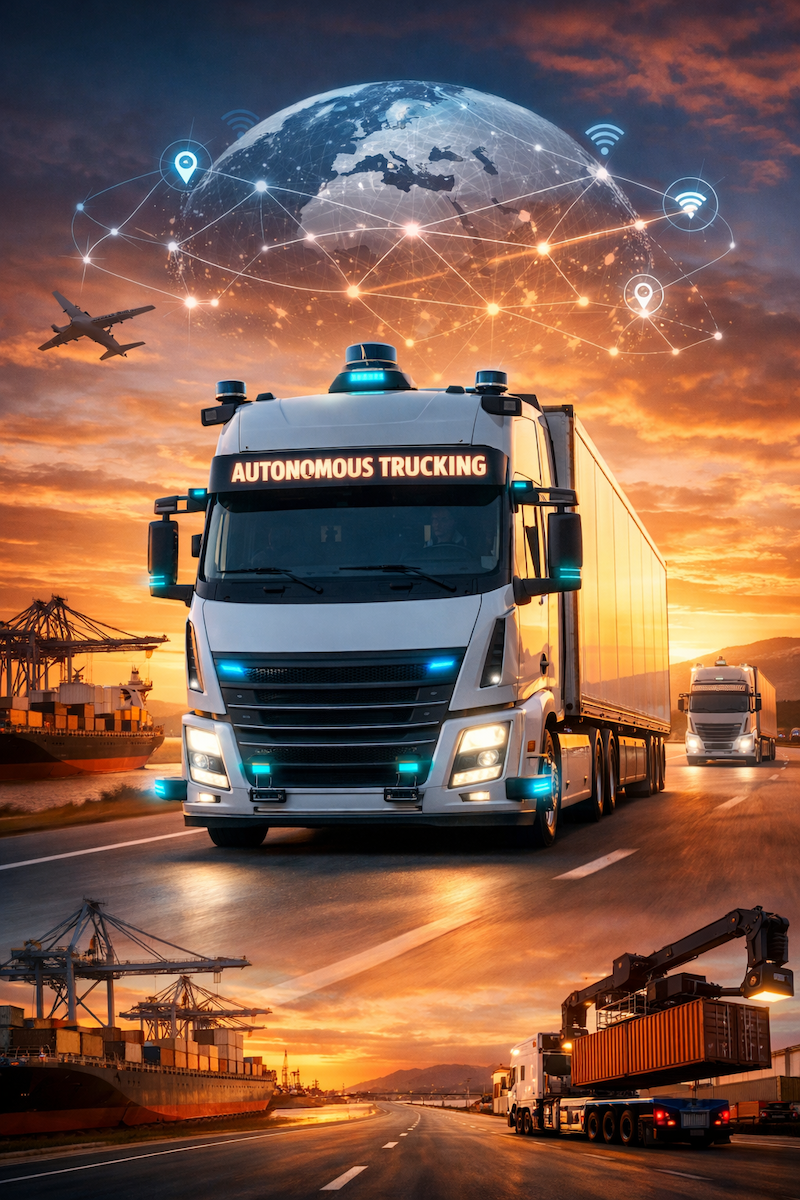
Progress, constraints, and the companies shaping long-haul autonomy
Autonomous vehicles are still widely framed through the lens of passenger cars and robotaxis. Yet the strongest commercial momentum in vehicle autonomy is emerging far from city streets and consumer ride-hailing apps.
It is taking shape on highways, distribution corridors, and freight routes where economics, not novelty, determine success.
Long-haul trucking has become the most credible proving ground for autonomous driving. The sector combines chronic labour shortages, rising logistics costs, predictable operating patterns, and a clear productivity incentive.
For investors, it also offers something that robotaxis have struggled to deliver: a path to revenue that scales incrementally rather than all at once.
The question is no longer whether autonomous trucking works in principle, but whether it can mature into a repeatable, investable industrial system.
Why trucking, not robotaxis, leads the autonomy business case
Freight transport is structurally different from consumer mobility.
Long-haul trucking operates on relatively stable routes, primarily highways, with fewer unpredictable interactions than dense urban driving. Trucks are also capital assets expected to maximise utilisation over long service lives, making even small efficiency gains economically meaningful.
Key drivers include:
- Persistent driver shortages across North America and parts of Europe
- Pressure on fleets to extend operating hours without breaching labour rules
- Rising insurance, fuel, and downtime costs
- Growing demand for predictable, time-critical freight movement
Autonomous trucking is therefore positioned not as a replacement for logistics networks, but as a force multiplier within them.
What ‘autonomous trucking’ actually means in practice
Much of the confusion around autonomous vehicles comes from imprecise language.
Most autonomous trucking programmes today focus on hub-to-hub highway autonomy, rather than door-to-door automation. Human drivers typically handle first- and last-mile operations, while autonomy systems manage long highway segments under defined conditions.
In practice, this means:
- Highly geofenced routes
- Restricted weather and visibility parameters
- Continuous remote supervision
- Gradual reduction – not elimination – of in-cab human roles
This constrained approach is not a weakness. It is the reason trucking autonomy has advanced further commercially than urban robotaxis.
The technology stack behind autonomous long-haul trucks
From a systems perspective, autonomous trucks resemble mobile industrial machines more than consumer vehicles.
Heavy trucks offer more space and power for compute and sensing, enabling redundant architectures that are difficult to implement in passenger cars.
Core components typically include:
- Long-range LiDAR for forward perception at highway speeds
- Radar for all-weather object detection
- Multi-camera arrays for classification and situational awareness
- High-performance onboard compute platforms
- Sensor fusion software that prioritises fail-safe behaviour over edge-case performance
Crucially, highway autonomy prioritises stability and predictability, not aggressive manoeuvring or urban navigation.
Deployment reality: Where autonomous trucks actually operate
Despite ambitious marketing claims, autonomous trucking remains geographically selective.
Most real-world deployments focus on:
- US Southwest highway corridors
- Relatively flat terrain
- Predictable traffic patterns
- Limited seasonal weather variation
This deliberate narrowing of operational design domains has enabled consistent pilot operations and early commercial freight runs. Nationwide autonomy is not the near-term objective. Network depth matters more than geographic breadth.
The capital markets signal: Autonomous trucking reaches the stock exchange
From venture capital to public markets
A critical inflection point for any emerging technology sector is its transition from venture-backed experimentation to public-market validation. Autonomous trucking has now crossed that threshold.
In 2025, Kodiak Robotics became one of the first pure-play autonomous trucking companies to list on a public stock exchange via a SPAC transaction (TuSimple achieved an earlier listing via a traditional IPO).
Kodian’s move signalled that investors are no longer treating autonomous trucking solely as a long-dated R&D bet, but as a commercial infrastructure play.
Public listings change the narrative. They impose financial discipline, reporting transparency, and market-based valuation on autonomy developers – while also giving institutional investors direct exposure to the sector.
Why investors care
Autonomous trucking aligns well with public-market expectations because it offers:
- Long-term contracts rather than consumer demand volatility
- Capital equipment economics familiar to industrial investors
- Clear total addressable market definitions
- Gradual deployment curves that reduce binary risk
This makes the sector more comparable to industrial automation than consumer technology.
Autonomous trucking companies likely to follow Kodiak
Several autonomous truck technology providers appear structurally positioned for eventual public listings, whether through IPOs, SPACs, or acquisitions that later spin out:
- Aurora Innovation – Strong OEM partnerships and a focus on scalable autonomy platforms
- Plus AI– Deep integration with commercial truck manufacturers and a clear international strategy
- Waabi – AI-centric approach attracting long-term technology investors
- Einride – Combining autonomy with electrification and logistics services
Not all of these companies will list independently. Some may be absorbed by OEMs or logistics platforms. But the direction is clear: autonomous trucking is becoming a financial asset class, not just a technical experiment.
Regulation, liability, and why trucking may move first
From a regulatory perspective, trucking autonomy benefits from a pragmatic framing. It is easier to regulate a limited number of controlled highway routes than complex urban passenger environments.
Key regulatory dynamics include:
- State-by-state frameworks in the US
- Ongoing debates around liability allocation between OEMs, software providers, and fleet operators
- Safety validation through operational statistics rather than theoretical capability
Importantly, freight autonomy does not require immediate public trust in the same way passenger autonomy does. Cargo does not vote.
Labour impact: Automation without total displacement
While trucking jobs carry political sensitivity, autonomous systems are more likely to restructure roles than eliminate them outright.
Probable outcomes include:
- Reduced long-haul driving hours
- Increased local and regional driving roles
- Growth in fleet supervision, maintenance, and remote operations jobs
This mirrors automation patterns already seen in ports, warehouses, and mining operations.
Commercial timelines: What success actually looks like
Autonomous trucking will not arrive everywhere at once.
Success is more likely to emerge as:
- Specific freight lanes operating with high autonomy utilisation
- Certain cargo classes prioritised for autonomous transport
- Hybrid human-autonomy fleets becoming standard
From an investment standpoint, this incrementalism is a feature, not a flaw.
Autonomous trucking as investable industrial automation
Autonomous trucking is not a speculative moonshot. It is an industrial optimisation problem with measurable economics, bounded risk, and growing institutional interest.
As companies like Kodiak transition into public markets, the sector is entering a new phase – one defined less by technical demos and more by balance sheets, contracts, and execution.
For investors, autonomous trucking may represent the most commercially credible path to vehicle autonomy at scale. For the automation industry, it is another sign that robotics and AI are becoming infrastructure – not spectacle.
