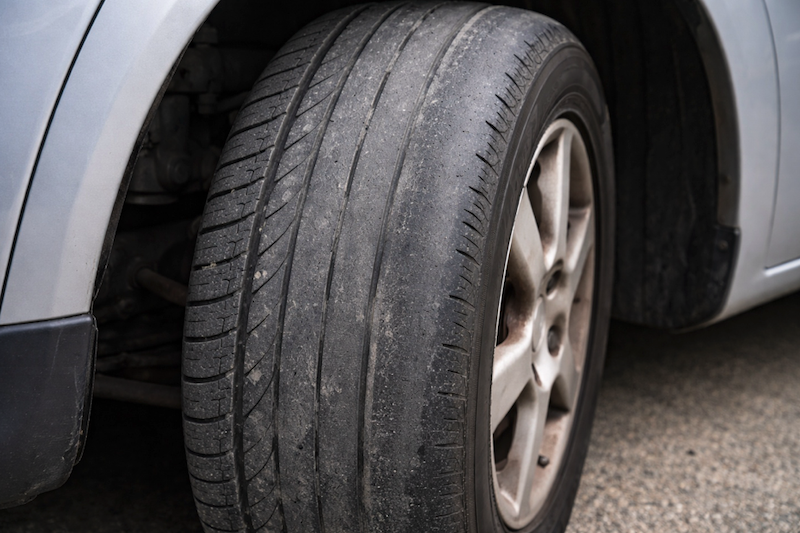
Tire wear patterns on all-wheel-drive vehicles demand special attention. Uneven tire wear can damage the AWD system itself, making early diagnosis critical for safety, performance, and long-term cost control.
Why Tire Wear is More Critical on AWD Vehicles
All-wheel-drive (AWD) systems distribute power to all four wheels, either full-time or on-demand. Unlike front-wheel-drive or rear-wheel-drive vehicles, AWD systems rely on consistent tire circumference and traction across all four tires to function correctly.
Even minor differences in tread depth can:
- Confuse AWD sensors
- Force differentials to work constantly
- Cause drivetrain binding
- Lead to premature transfer case failure
This is why tire wear patterns on AWD vehicles are not just a tire issue – they are a powertrain reliability issue.
How AWD Systems Influence Tire Wear
AWD vehicles create unique wear characteristics due to:
- Continuous torque distribution across axles
- Increased vehicle weight
- Higher traction demands
- More complex differentials and couplings
Unlike FWD or RWD vehicles, AWD tires must work as a matched set. Any uneven wear pattern increases mechanical stress throughout the drivetrain.
Common Tire Wear Patterns on AWD Vehicles
1. Uneven Wear Between Axles (Front vs Rear)
What it looks like: Front tires wear significantly faster or differently than rear tires.
Primary causes:
- Missed tire rotations
- Aggressive driving
- Front-heavy vehicle design
Why it’s dangerous on AWD: Different rolling diameters force the AWD system to constantly compensate, overheating differentials.
Corrective actions:
- Rotate tires every 5,000-7,000 miles
- Use identical tire models and sizes
- Replace tires as a full set when required
2. Inner Edge Wear Across Multiple Tires
What it looks like: Inside shoulders of two or more tires wear prematurely.
Primary causes:
- Excessive negative camber
- Sagging suspension components
- Misalignment under load
AWD-specific concern: Because AWD vehicles are heavier, worn suspension components accelerate camber-related wear.
Corrective actions:
- Perform load-based alignment
- Inspect control arms, bushings, and struts
3. Cupping or Scalloping on One or More Tires
What it looks like: Alternating high and low tread spots.
Primary causes:
- Worn shocks or struts
- Wheel imbalance
- Loose suspension components
Why AWD vehicles are prone: Additional drivetrain weight increases vertical load, amplifying suspension weaknesses.
Corrective actions:
- Replace worn dampers
- Balance tires precisely
- Torque suspension hardware correctly
4. Feathering on All Four Tires
What it looks like: Sharp tread edges when running a hand across the tire.
Primary causes:
- Incorrect toe alignment
- Worn steering components
AWD impact: Because all wheels receive power, toe errors affect every tire – not just the driven axle.
Corrective actions:
- Perform four-wheel alignment
- Inspect tie rods and steering rack mounts
5. Diagonal or Irregular Wear Patterns
What it looks like: Uneven wear appearing diagonally across the tread.
Primary causes:
- Mismatched tire brands or tread patterns
- Inconsistent rolling resistance
Why it’s critical on AWD: AWD systems are calibrated for uniform traction. Mismatched tires disrupt torque distribution.
Corrective actions:
- Use identical tires on all four corners
- Avoid mixing new and heavily worn tires
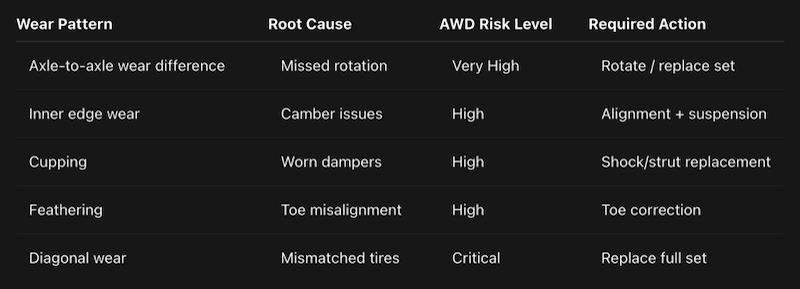
Table: AWD Tire Wear Patterns and Risk Levels
Why Mismatched Tire Wear Can Destroy AWD Systems
Many AWD systems use:
- Center differentials
- Viscous couplings
- Electronic clutch packs
When tire diameters differ, these components constantly slip to compensate – causing heat buildup and internal damage.
Manufacturers often specify maximum tread depth variation (commonly 2/32 inch). Exceeding this can void drivetrain warranties.
Driving Habits That Accelerate AWD Tire Wear
- Aggressive acceleration
- Hard cornering
- Towing beyond capacity
- Infrequent tire rotation
- Mixing tire brands or tread designs
AWD traction can mask early wear symptoms, making visual inspection even more important.
When AWD Tire Wear Becomes a Safety Risk
Immediate replacement or repair is required if you notice:
- Uneven wear across multiple tires
- Vibration during acceleration
- Binding or hopping during tight turns
- Warning lights related to traction or AWD systems
These symptoms often indicate drivetrain stress – not just tire degradation.
Preventing Uneven Tire Wear on AWD Vehicles
AWD-Specific Prevention System
- Rotate tires every 5,000-7,000 miles
- Maintain equal tire pressure on all wheels
- Replace tires as a complete set when possible
- Perform four-wheel alignment annually
- Inspect suspension components regularly
- Avoid mixing tire models or tread depths
This system protects both tires and the AWD drivetrain.
FAQ: AWD Tire Wear Patterns
Can I replace just one tire on an AWD vehicle?
In most cases, no. Replacing a single performance tire can create diameter differences that damage the AWD system.
Why do AWD vehicles require more frequent rotations?
Because all tires are driven, wear accumulates faster and unevenly without regular rotation.
Is uneven tire wear more expensive on AWD vehicles?
Yes. Ignoring wear can lead to costly differential or transfer case repairs.
How much tread difference is safe on AWD tires?
Most manufacturers allow no more than 2/32 inch difference between tires.
Key Takeaways
- AWD tire wear affects drivetrain health
- Uneven wear is more dangerous than on FWD or RWD
- Matching tires is critical
- Regular rotation and alignment are mandatory
Conclusion
Tire wear patterns on all-wheel-drive vehicles require proactive maintenance and strict consistency. Uneven wear not only reduces traction but can permanently damage expensive drivetrain components.
If your AWD vehicle shows uneven tire wear, address it immediately – protecting your tires also protects your entire powertrain.
