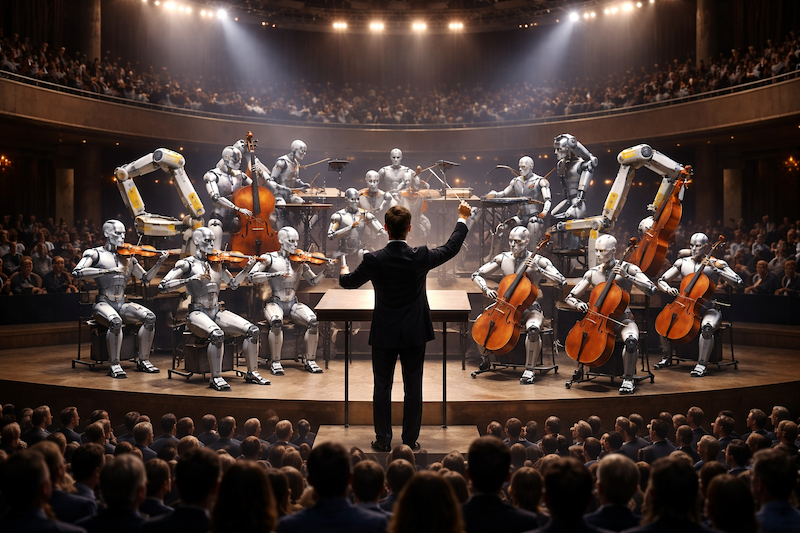
For decades, industrial robots have grown steadily more capable. Modern robot arms can move faster, more smoothly and more precisely than ever before, executing complex, multi-axis motion with sub-millimetre repeatability in harsh industrial environments.
Yet for many manufacturers, programming these machines remains one of the biggest obstacles to wider automation. The issue is not that robot software is inherently weaker than robot hardware, nor that robots are approaching human-level dexterity.
Rather, it is that the ways humans interact with industrial robots have not kept pace with the mechanical capabilities of the machines themselves.
As factories face labour shortages, shorter product cycles and rising product variation, this mismatch between robot potential and programming effort is becoming increasingly difficult to ignore.
From teach pendants to digital workflows
Traditional robot programming methods were developed for a very different manufacturing era. Teach pendants, point-to-point motion and vendor-specific programming languages worked well when robots performed a single task for years at a time.
Today’s factories are more dynamic. Production lines are reconfigured more frequently, batch sizes are smaller, and product variation is higher. In this environment, stopping production to manually re-teach robot positions is expensive and disruptive.
This has driven growing interest in programming approaches that move robot work out of the physical factory and into digital environments.
Offline programming: separating programming from production
Offline programming allows engineers to create and test robot programs without interrupting live operations. Using virtual models of robots, tooling and workcells, tasks can be programmed, simulated and validated before being deployed on the shop floor.
The advantages are well established. Downtime is reduced, commissioning is faster, and potential collisions or reach issues can be identified early. Offline programming also enables engineers to explore alternative layouts or motion paths without physical trial and error.
However, offline programming is not a complete solution. Its accuracy depends heavily on calibration and the quality of digital models. Differences between simulated and real-world behaviour still require adjustment during deployment, and many tools remain complex enough to demand specialist expertise.
Simulation and digital twins move beyond validation
Simulation tools have evolved significantly in recent years. What began as a way to check for collisions is increasingly used to optimise cycle times, energy consumption and system throughput.
Digital twins of robot cells can now incorporate physics-based models, sensor behaviour and real production data. This allows simulations to be used not only before deployment, but throughout the system’s operational life.
In practice, this means robot programming is gradually shifting from a one-time setup task to a continuous optimisation process, where performance improvements are driven by data rather than intuition alone.
Low-code and no-code interfaces: lowering the barrier
One of the most visible trends in robot programming is the emergence of low-code and no-code interfaces. These systems aim to abstract away traditional robot languages in favour of graphical workflows, reusable skills and task-level commands.
For manufacturers, the appeal is clear. Shorter learning curves make it easier to involve technicians and operators, rather than relying exclusively on scarce robot specialists. Redeploying robots for new products becomes faster, supporting high-mix, low-volume production.
That said, abstraction has limits. Highly dynamic tasks, tight tolerances and complex edge cases often still require deep control over motion and logic. Low-code tools work best when they complement, rather than replace, more detailed programming methods.
Programming by demonstration and intent
Another approach gaining traction is teaching robots through physical interaction. Hand-guiding, kinesthetic teaching and vision-based demonstration allow operators to show robots what to do rather than describe it step by step.
These techniques are particularly effective for collaborative robots and simpler industrial tasks, where paths and forces can be inferred from demonstration. They reduce setup time and align more closely with how humans think about work.
Scaling these methods to faster, heavier or more safety-critical applications remains challenging. Demonstration still needs to be translated into reliable, repeatable motion under real production constraints.
The role of AI in robot programming
Artificial intelligence is increasingly used to assist robot programming, particularly in perception, path planning and error recovery. AI systems can help robots adapt to variation, detect anomalies and refine motion based on experience.
Importantly, most current applications focus on assisted programming, not fully autonomous robots. The goal is to reduce human workload and improve robustness, rather than eliminate human oversight.
Natural language interfaces and higher-level task descriptions are often discussed, but in industrial settings reliability and predictability remain paramount. Progress is likely to be incremental rather than revolutionary.
An ecosystem problem, not just a software one
Despite technical advances, robot programming remains fragmented. Robot manufacturers, software vendors and system integrators each provide their own tools, often with limited interoperability.
As a result, ease of programming is shaped as much by ecosystem integration as by user interface design. Open standards, better data exchange and closer links between design, simulation and execution environments are increasingly important.
What this means for manufacturers
For manufacturers, easier robot programming lowers the barrier to automation. Systems that can be deployed and redeployed quickly offer faster return on investment, particularly for smaller companies and variable production environments.
Rather than focusing solely on raw speed or payload, many buyers now prioritise flexibility, ease of use and lifecycle efficiency.
What will not change
Despite rapid progress, industrial robots will not become plug-and-play machines overnight. Safety validation, system integration and process understanding will continue to require expertise.
The long-term trend, however, is clear. Robot programming is moving away from detailed motion control toward higher-level descriptions of intent and outcome.
The factories that benefit most will be those that can bridge the gap between human understanding and machine execution – not by making robots human-like, but by making them easier for humans to work with.
Comparison table: Traditional vs offline vs low-code programming
| Aspect | Traditional teach-pendant programming | Offline programming & simulation | Low-code / no-code interfaces |
|---|---|---|---|
| Primary interaction | Manual point teaching on the physical robot | Programming in a virtual environment | Graphical workflows, task blocks, skills |
| Production impact | Requires stopping or slowing production | No production interruption during programming | Minimal interruption; often configurable live |
| Typical users | Robot specialists, integrators | Engineers, advanced programmers | Technicians, operators, automation engineers |
| Setup speed | Slow for new tasks or changes | Faster once models are available | Fast for standardised tasks |
| Flexibility | Low for frequent changeovers | High for layout and path changes | High within defined task boundaries |
| Accuracy dependence | Physical teaching accuracy | Calibration and digital twin quality | Abstraction quality and sensor input |
| Complex task handling | Strong, but labour-intensive | Strong, with upfront modelling effort | Limited for edge cases and high precision |
| Scalability | Poor across multiple cells | Good across standardised cells | Good for repeatable deployments |
| Learning curve | Steep | Moderate to steep | Shallow |
| Main limitation | Time, downtime, specialist dependence | Model fidelity and setup effort | Loss of fine-grained control |
