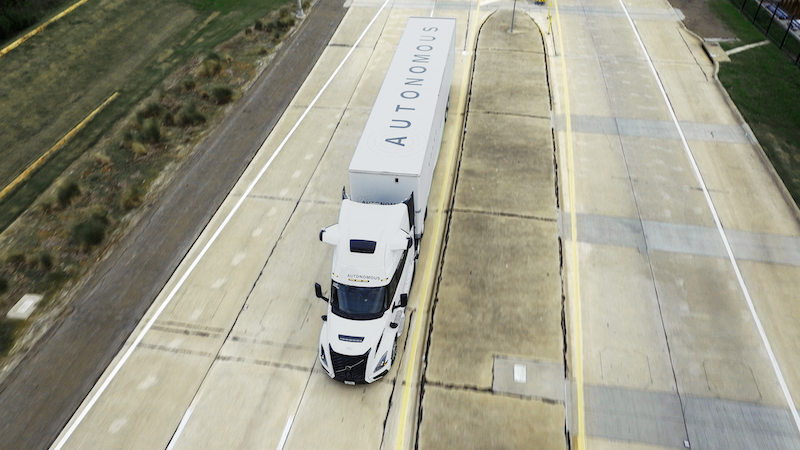
Autonomous trucking is edging closer to commercial reality in the United States, but the companies leading the technology are finding that the real challenge is no longer just developing a safe self-driving system.
It is building the ecosystem around it: the infrastructure, service network, regulations, operational playbooks and commercial partnerships needed to scale autonomous freight in a predictable, reliable and economically viable way.
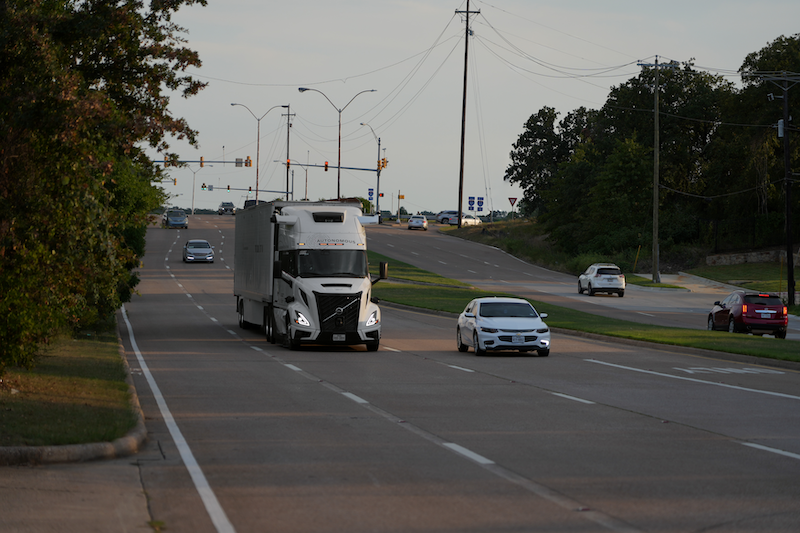
Few companies have gained as much real-world experience as Volvo Autonomous Solutions. While much of the industry is still testing prototypes or running closed pilots, Volvo is already hauling commercial freight between Dallas and Houston using the Volvo VNL Autonomous integrated with the Aurora Driver. (VNL is the name of Volvo Trucks’ long-haul, Class 8 tractor platform for the North American market.)
Loads for partners such as DHL and Uber Freight are moving today, offering early insight into how autonomous operations behave when placed under real customer expectations and logistics pressures.
This operational experience is informing Volvo’s long-term strategy. Unlike manufacturers that treat autonomy as an optional upgrade or a speculative research programme, Volvo has established autonomy as a dedicated business area, with a clear roadmap toward scaled deployment.
The company is also investing heavily in an integrated manufacturing strategy: the VNL Autonomous is assembled in Virginia at Volvo Trucks’ New River Valley facility, where hardware from partners Aurora and Waabi is incorporated directly on the production line – a sign that Volvo is preparing for autonomy at industrial scale, not as an experimental sideline.
Against this backdrop, we spoke with Sasko Cuklev, head of on-road solutions at Volvo Autonomous Solutions, to discuss how close the industry is to widespread deployment, what Volvo has learned from its early freight operations, and why building a complete autonomy ecosystem is essential for the technology to become commercially sustainable.
His answers offer a clear, candid view of where autonomous trucking stands today – and what the next phase of growth will require.

Interview with Sasko Cuklev
Robotics & Automation News: How central is autonomy to Volvo’s long-term strategy? Volvo seems more committed to autonomous trucks than most manufacturers. Is autonomy seen as a core business for the next decade, or more as an experimental adjunct to traditional trucking?
Sasko Cuklev: Autonomy is a key part of Volvo’s long-term vision. We view autonomous transport solutions as a way to address major industry challenges, such as driver shortages, rising freight demand, and long transit times.
Volvo is making autonomy central to its business, not just an experiment and since 2020, we have a dedicated business area to commercialize autonomous transport solutions in key industry sectors – Volvo Autonomous Solutions.
R&AN: How close are we to large-scale commercial deployment? You’re already operating routes between Dallas and Houston. What are the next technical and regulatory milestones before Volvo’s autonomous trucks can operate freely across the US highway network?
SC: We are already in commercial deployment – operating routes like Dallas to Houston with the Volvo VNL Autonomous integrated with the Aurora Driver, pulling loads for customers like DHL and Uber Freight.
For widespread deployment across the US, additional technical advancements must be achieved, and key regulatory milestones – including the establishment of a comprehensive national framework – are necessary to ensure consistent standards and safe integration of autonomous trucks into the broader transportation network.
R&AN: What lessons have emerged from real-world freight operations? From your partnerships with DHL and Uber Freight, what have you learned about the practical challenges – and customer expectations – of integrating autonomous trucks into logistics networks?
SC: Experiences with partners like DHL and Uber Freight have highlighted both the practical challenges and customer expectations of integrating autonomous trucks into logistics networks. The main takeaway is that autonomous solutions complement current transport systems and need to be implemented purposefully.
R&AN: Can you explain Volvo’s ‘ecosystem’ approach to autonomy? You’ve said the ecosystem around autonomous trucking – including infrastructure, teleoperation, service, and insurance – is critical. How is Volvo building that ecosystem, and who are the key partners?
SC: Our ecosystem approach recognizes that the success of autonomous trucking depends on more than just advanced vehicles – it requires comprehensive infrastructure, dedicated services, and strategic partnerships.
To support the Volvo VNL Autonomous, we are collaborating with Volvo Trucks dealers to establish a robust support and uptime network. Additionally, our strong partnerships with Aurora and Waabi focus on integrating their self-driving technologies into the Volvo VNL Autonomous, to create safe and efficient autonomous transport solutions.
R&AN: How do safety and redundancy shape Volvo’s design philosophy? The VNL Autonomous has redundant safety systems for steering and braking. How different is its architecture from a conventional truck, and how does Volvo test and validate these systems for public-road reliability?
SC: Safety and redundancy are key to our design philosophy. The Volvo VNL Autonomous has been purpose-built for autonomy from the ground up, incorporating redundant systems for safety critical functions. For example, both steering and braking have backup systems, so if one system fails, another can take over to maintain safe operation.
This approach marks a significant advancement over conventional trucks, which typically rely on single systems, and underscores Volvo’s commitment to reliability and public road safety.
We rigorously validate these redundancies through fault injection and automotive-grade testing. Our partner, Aurora, tests and verifies the performance of the virtual driver, using a combination of simulations and real-world driving to ensure our autonomous technologies operate safely and reliably in diverse conditions.
R&AN: What role do partners like Aurora and Waabi play in the autonomy stack? Volvo’s strategy includes collaboration rather than in-house autonomy development. How do you ensure tight integration between Volvo’s hardware and external AI or perception software partners?
SC: Our collaboration with Waabi and Aurora is focused specifically on the highway segment, where we are integrating their self-driving technologies – the Waabi Driver and Aurora Driver – into the Volvo VNL Autonomous.
In the mining segment, we develop our own virtual driver in-house and leverage that expertise and knowledge in our partnership with Aurora.
Regarding integration, our industrialization strategy is key: we are currently integrating the Aurora Driver with the Volvo VNL Autonomous on the pilot line at our New River Facility, ensuring tight alignment of the Aurora Driver hardware with OEM-grade quality directly on the production line. Our intention is to apply the same approach to line integration with Waabi.
R&AN: When do you see the economics of autonomy becoming self-sustaining? Volvo has the brand trust and manufacturing scale, but widespread adoption requires clear cost benefits. When do you expect autonomous freight to become not just possible, but profitable?
SC: We are already seeing tangible benefits from autonomous transport today. For example, our fully driverless commercial mining operations in Sweden and Norway have demonstrated improvements in safety, continuous round-the-clock operations, and even production. These advancements highlight the unique value that autonomy brings.
It’s important to recognize that making a direct comparison between today’s trucking operations and autonomous transport is challenging, as autonomy introduces new forms of value creation.
Autonomous vehicles are capable of operating without the constraints of mandatory driver breaks or hours of service limitations, enabling goods to be transported much faster and more efficiently.
To illustrate; a conventional truck typically requires about five days to complete the journey from California to Chicago. In contrast, the Volvo VNL Autonomous can complete the same trip in just two days, thanks to its ability to operate continuously without interruption.
This reduction in transit time not only improves supply chain efficiency but also creates new opportunities for businesses to respond to market demands more swiftly.
