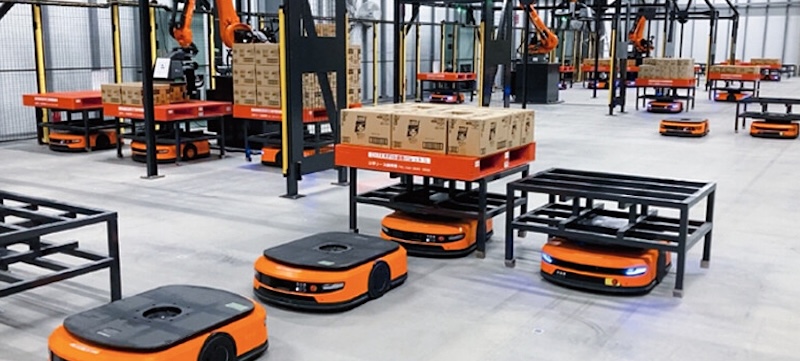
NTT, NTT Docomo Business and robotics firm Mujin have entered into a capital and business alliance aimed at accelerating the development of physical AI and autonomous robot technologies across manufacturing and logistics.
The agreement, signed on December 1, brings together NTT’s telecommunications, cloud and AI infrastructure with Mujin’s robot-control and digital-twin technologies, including its proprietary operating system “MujinOS”, a platform that the companies say “realizes robot intelligence and digital twins of entire factories and warehouses”.
The companies say the partnership is driven by rapid growth in the robotics automation market, fuelled by “global labor shortages, rising labor costs due to inflation, and advances in AI technology”.
Demand is increasing for “intelligent robots” capable of sensing, reasoning and autonomously adapting to their environment, rather than following fixed, pre-programmed motions.
Mujin has responded with its “integrated automation platform” MujinOS, which uses advanced recognition, motion planning and real-time digital-twin technologies to unify robots, sensors and warehouse management systems into a single control layer.
According to the company, this framework eliminates the need for complex system integration and allows “rapid deployment of reliable automation solutions”.
Digital-twin systems such as MujinOS continuously gather “vast amounts of information” required for physical-AI computation. As operational data increases, NTT argues that robust AI-centric infrastructure – including networks, cloud platforms and data-centre capacity – will be essential for managing and utilising that information securely and efficiently.
NTT Docomo Business has been developing a next-generation “AI-Centric ICT Platform”, which integrates network functions, security, NaaS, data-centre services and managed operations. Under the alliance, this infrastructure will be combined with Mujin’s automation software to deliver “safe and secure robot automation solutions”.
NTT says the agreement aligns with the group’s broader strategy around “data-driven new value creation”, including initiatives in optical networking through its IOWN concept, generative AI and human-robot interaction technologies.
By combining these capabilities with Mujin’s control stack, the companies aim to support autonomous industrial systems across sectors beyond manufacturing and logistics.
Under the capital portion of the agreement, NTT and NTT Docomo Business will invest in Mujin through a third-party allocation of new shares.
As part of the business alliance, the companies plan to co-develop new automation solutions for logistics and manufacturing, using a combination of digital infrastructure and robotics. Joint activities will include:
- providing new robot-automation and digital-transformation solutions for industrial customers
- leveraging the customer bases of both groups to create new business opportunities
- offering jointly delivered consulting and “Digital BPO” services covering networks, security, cloud and industrial operations
- exploring future business areas based on MujinOS, including applications that use generative AI and human-robot interaction to increase robot autonomy and flexibility
NTT, NTT Docomo Business and Mujin say the partnership will help advance “autonomous, automated society” while addressing industrial challenges such as labour shortages, safety risks and productivity pressures.
