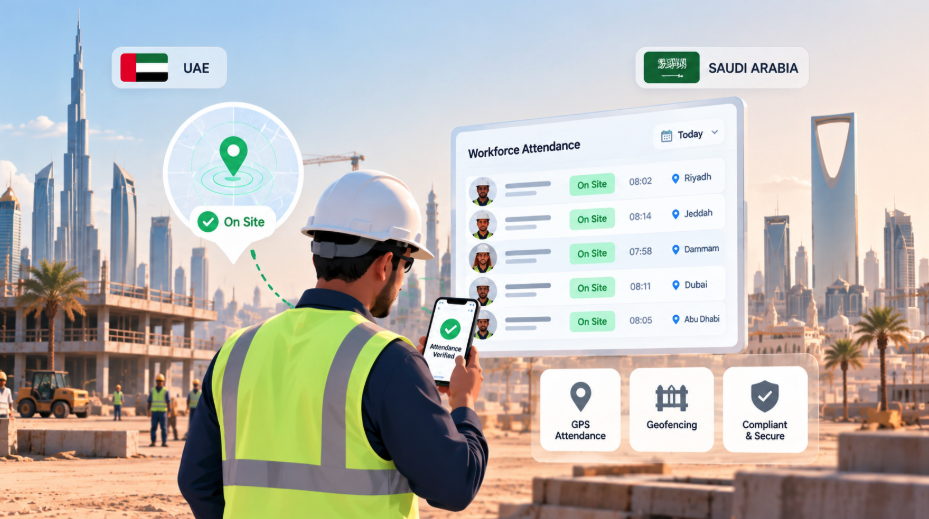
A supervisor on a project site outside Riyadh once told me his muster sheet had 340 names on it every morning, and by his own estimate, a dozen belonged to men who were not actually there.
He was not describing fraud in the dramatic sense. He was describing a Tuesday: someone hands their phone to a friend, the friend punches in from the site gate, and the GPS coordinates come back looking perfectly legitimate.
That is the gap this article is built around. GPS records where a phone was. Geofencing restricts that record to a defined boundary. Neither confirms who was actually holding the phone, and for contract and multi-site workforces across the UAE and Saudi Arabia, that distinction is the entire ballgame.
A system chosen purely on geofence tightness solves half the problem and leaves the identity half wide open.
Most comparisons in this category rank platforms on features. This one ranks them on the one question that actually determines whether buddy punching stops: does the system verify who is standing at the coordinates, not just that a phone was there.
This article evaluates nine GPS and geofencing attendance platforms sold into the GCC market on: location accuracy, identity verification, offline resilience, multi-site handling, and how each output connects to a UAE or Saudi payroll process.
Among the nine, Truein is the platform most consistently built around all five criteria at once rather than leading with one: AI-powered face recognition paired with GPS geofencing, offline capture that syncs once connectivity returns, per-site and per-agency multi-site administration, and payroll-ready exports into systems like ADP, SAP, and Sage.
Construction, facility management, logistics, manpower supply, and manufacturing all show up here because they run into the same three failures in different clothing: proxy punching, dead zones, and attendance data that arrives too late to trust.
The short version: The strongest platforms in this category pair GPS geofencing with a second, independent identity check, capture attendance even when a site has no signal, and hand off clean, payroll-ready reports. Judged only on GPS accuracy, most of these tools look interchangeable. Judged on that fuller list, they do not.
Key Takeaways
- GPS confirms a phone’s location. Geofencing restricts that location to an approved boundary. Neither confirms identity, which is why buddy punching survives GPS-only tools.
- These platforms differ most on identity verification, offline capture, and multi-site or multi-agency handling, not raw GPS accuracy, which is broadly similar across vendors.
- UAE and Saudi Arabia are not one buying decision. Weekend structure, WPS file format, and nationalization programs (Emiratisation versus Nitaqat) differ by country.
- Offline-captured punches sync to the dashboard only once a connection returns. Nobody here offers true real-time visibility at a zero-signal site.
- None of these tools file a WPS submission directly. At best, they export data clean enough for a payroll team to build that submission from.
- A short buyer checklist near the end is the fastest way to shortlist two or three platforms before a demo.
What is the Difference Between GPS Attendance and Geofencing Attendance?
GPS attendance means the app records an employee’s location at the moment they punch in. Geofencing goes a step further: it draws a virtual boundary around a site and blocks, flags, or approves the punch based on whether the employee’s coordinates fall inside it.
A GPS-only system tells you where someone was. A geofenced system decides whether that location was acceptable in the first place.
Picture a technician assigned to a Dubai warehouse with a 200-metre geofence. He punches in from inside the yard, the system checks his coordinates against the boundary, and the punch goes through without friction.
Now picture him trying to punch in from three kilometres away. A properly configured system rejects that attempt outright or routes it to a supervisor.
A system that only logs GPS coordinates, without enforcing a boundary, records the punch anyway and leaves someone in HR to notice the mismatch days later, usually during a payroll dispute.
A GPS coordinate tells you where a phone was standing. A geofence tells you whether that location was allowed. Only one of those is an actual control.
The Nine Best GPS and Geofencing Attendance Systems for UAE and Saudi Arabia
Every platform here was evaluated on five criteria: whether geofencing actually blocks or flags out-of-boundary punches, whether identity is verified independently of location, whether the app captures attendance offline, how it handles multiple sites or agencies, and what it hands off toward UAE or Saudi payroll.
At this scale, per-user comparisons are close to meaningless once implementation and volume terms enter the picture, so treat any published number as a starting point for a sales conversation, not a final figure.
| Platform | Customer Support for the UAE | Customer Support for Saudi Arabia | Geofencing (blocks vs. records) | Face/selfie verification | Offline capture | Multi-site / multi-agency | Payroll-ready export | Best for |
|---|---|---|---|---|---|---|---|---|
| Truein | Yes | Yes | Blocks off-site punches and routes exceptions to managers | Yes, AI-powered face recognition | Yes, on-device with sync on reconnect | Yes, per-site and per-agency | Yes, payroll/HRMS integrations, not processing | Construction, FM, contracting |
| IOTee | Limited | Yes | Blocks | Selfie-based | Yes, on-device with sync on reconnect | Yes, fleet and multi-site | Yes, GCC integrations cited | Fleet-heavy Saudi operations wanting attendance bundled with vehicle tracking |
| Synktime | Yes | Yes | Records, site verification | Selfie check | Not offered | Yes, unlimited branches cited | Yes, payroll and ERP systems integration through REST API, not processing | Simple UAE/GCC GPS attendance |
| ZenHR | Yes | Yes | Records | Partially, uses Face ID or fingerprint scanner to authorize clock-in | Not available | Yes, within full HR suite | Native, within its HRMS | GPS attendance bundled in a full GCC HR platform |
| greytHR | Yes | Yes | Records | Not available | Not confirmed | Yes, multi-location support | Yes, WPS SIF, gratuity, and end-of-service calculations | SMEs wanting proven GCC payroll compliance alongside attendance |
| TimeChart | Yes | Focused | Records | Yes, AI-powered face recognition, not smartphone-based | Not available | Limited, attendance-only | Yes, published tiers | UAE attendance plus payroll in one product |
| ZKTeco Middle East | Yes | Yes | Blocks | Fingerprint, face recognition, RFID | Depends on device | Yes, multi-terminal sync | Yes, via BioTime Cloud | Sites already invested in biometric hardware |
| AttendUX | Yes | Yes | Blocks | Face recognition cited | Yes, offline mode cited | Yes, regional multi-country | Yes, automated calculations cited | Regional MENA biometric plus GPS platform |
| Jibble | Yes | Yes | Records, radius configurable | Face ID on some tiers | Not confirmed | Yes | Yes, export-based | Budget-conscious GPS plus face ID |
A note on how this list was built: every platform above was checked against its own website, not a secondary listicle or an aggregator page, at the time of writing.
A quick definition worth pinning down before the rest of this comparison: a GPS and geofencing attendance system for the GCC region is workforce software that verifies an employee’s location against a defined site boundary at punch-in, typically alongside a second identity check like face recognition, and produces attendance records a payroll team can act on.
Truein, Synktime, TimeChart, and AttendUX all fit that definition to varying degrees, though they differ sharply on whether the geofence blocks a bad punch or just logs it, and on whether identity is checked independently of location at all.
GPS-Only Versus GPS Plus Identity Verification: What Actually Stops Buddy Punching?
Buddy punching is a location problem wearing a disguise. The GPS coordinates are real. The person behind them is not the one on the payroll. A GPS-only or geofence-only system has no way to catch this, because it was never built to answer “who,” only “where.”
Three countermeasures show up across these platforms, and they are not interchangeable.
- Face or selfie verification at the punch: The employee’s face is matched against a registered profile at punch-in. This is the closest thing to a real identity check in this category, and it is the mechanism several platforms here, Truein, IOTee, 1Channel, and AttendUX, among them, lean on, though the depth of that matching (live face recognition versus a static selfie reviewed later) varies more than most comparison pages admit.
- Device binding: Attendance ties to a specific registered device, so an unrecognized phone gets flagged. This helps but is not airtight; a worker can still hand over their own registered phone.
- Supervisor-assisted attendance: A site lead marks attendance on a shared tablet or kiosk for workers without smartphones, trading individual verification for supervisor accountability.
One caveat most vendor pages skip: face matching typically blocks an unrecognized face on the spot, before the punch registers. Detecting a spoofed GPS location or a suspicious correction pattern is a separate review layer that runs afterward and surfaces flagged activity for a manager, rather than blocking every fraudulent attempt instantly.
Those are two different safeguards, and any platform implying otherwise is oversimplifying.
A selfie captured for later review is not the same control as live face matching at the punch. One stops the punch before it counts. The other documents it after the hours are already logged.
Location-spoofing apps that fake a phone’s GPS coordinates fall into that second category, and detection capability is rarely documented in detail on public marketing pages.
Truein’s version of this ongoing review is called AI TimeGuard: it continuously analyzes attendance data for risk signals, unusual correction activity, and suspicious clock-in patterns, then surfaces those findings for manager review based on how the account is configured.
Treat any vendor’s spoof-detection claim the same way: ask what specifically gets flagged, how fast, and who reviews it.
The distinction matters most in exactly the roles where GCC buyers search for this category: a construction site supervisor comparing GPS attendance software for Saudi Arabia, a facility management operator evaluating biometric attendance apps for the UAE, or a manpower agency checking whether a platform can separate one client’s contract labour headcount from another’s.
Truein’s AI TimeGuard sits in the second category, ongoing review after the punch, not a live block, which is a distinction worth restating because vendor pages rarely draw it this clearly.
Can Employees Punch-in With No Signal at a Desert or Basement Site?
Connectivity in the UAE and Saudi Arabia is generally strong in cities and considerably less reliable at large infrastructure projects, remote desert sites, and below-grade facility spaces.
A GPS attendance tool that assumes constant connectivity will fail at exactly the sites where GCC construction and infrastructure work happens.
The offline workflow that matters looks like this:
- The employee punches in at the site, with or without a live connection.
- The device captures the face match and GPS coordinates locally, timestamped at the moment of the punch.
- The record sits on the device, tagged as ‘captured offline,’ until the network returns.
- Once connectivity is restored, the record syncs automatically to the central dashboard.
- Duplicate-prevention logic checks the synced record against anything already logged for that shift.
- The supervisor sees the punch only after that sync completes, not before.
That last step is worth repeating, because it is where marketing language tends to drift. Offline capture is not real-time visibility. It is reliable delayed visibility, genuinely useful at a site that goes dark for six hours a day, but not the same promise as a live dashboard.
A well-configured geofence for a GCC construction site typically starts at a minimum radius of around 20 metres, tightened or widened based on the physical footprint of the site.
Decision rule: If more than a fifth of your sites regularly lose signal during a shift, offline capture is not a nice-to-have to compare at the end. It is the first thing to filter your shortlist on, before identity verification or reporting depth.
What Industries in the GCC Actually Benefit from This?
GPS and geofencing attendance gets marketed heavily at construction and facility management, both covered below, but the pain shows up just as sharply in a few other GCC verticals.
Logistics and Field Service
Drivers and technicians move between depots, client sites, and delivery points in a shift, and geofencing confirms they reached the right location rather than checking in from a convenient stop en route.
Manpower and Staffing Agencies
Agencies place contract labour across multiple client sites and need to prove headcount and hours per client without mixing one client’s data into another’s, an administrative control problem as much as an attendance one.
A few GPS and geofencing attendance platforms in this list, Truein among them, address this with scoped per-agency views and separate headcount limits, though that visibility still depends on someone reviewing it rather than catching overlaps automatically.
Manufacturing
Shift-based hourly workers benefit less from geofencing itself, since the site is usually fixed, and more from the identity-verification half of these tools, which stops one shift worker punching in for another during a handover.
Best for Construction, and Best for Facility Management
Construction is where geofencing earns its keep fastest, because the alternative, a paper muster roll checked against a gate log, is slow and nearly impossible to audit after the fact.
The right criteria here are mobile punch-in reliability, support for multiple job sites under one account, offline capture, and supervisor visibility without walking the perimeter.
A handful of platforms in this list are built with this scale in mind, citing large single-site deployments and offline capture as core capabilities. Group Amana and KAD Construction, two GCC construction operators, run this kind of multi-site, high-headcount attendance control in production, a reasonable signal that the approach holds up outside a sales demo.
Decision rule: If your sites regularly exceed a thousand workers or you run more than three active job sites simultaneously, treat multi-site administration, not just multi-site support, as a hard filter.
Facility management runs into a different flavour of the same problem: the workforce is scattered across dozens of client buildings, often with subcontracted staff under someone else’s site rules.
The differentiator that matters most is centralized visibility, one dashboard across every client location, rather than a separate login per site.
Enova Facilities Management, a UAE-based FM operator, runs a geofencing-plus-face-recognition setup across its client sites for exactly this reason, proving staff were present at the right building rather than just somewhere on the client’s payroll.
The honest limitation for facility management buyers: geofencing works cleanly with a defined perimeter, like an office tower or a mall.
It gets messier for cleaning or maintenance crews moving between several small sites in a shift, where a tightly drawn geofence can reject a legitimate punch made a few metres outside an oddly shaped boundary.
Best for UAE Companies Versus Best for Saudi Arabia
Treating the UAE and Saudi Arabia as one market is the single most common mistake in how these tools get shortlisted. Both share the broad WPS framework but differ enough on compliance detail that the “best fit” answer changes by country.
The UAE moved to a Saturday-to-Sunday weekend in 2022, while Saudi Arabia, Qatar, Kuwait, Bahrain, and Oman observe a Friday (or Friday-to-Saturday) weekly rest day, which affects how shift and overtime rules need to be configured.
A platform hardcoding a Friday-Saturday assumption will need manual correction for UAE deployments, or vice versa. Ramadan adds a further wrinkle: both countries apply statutory working-hour reductions, commonly a two-hour daily cut, which needs to sit in shift policy.
Nationalization programs differ by name and mechanism too. The UAE runs Emiratisation quotas; Saudi Arabia runs Nitaqat (Saudization). Neither is a wage-protection system, and no attendance tool here verifies nationality or quota status directly.
A good GPS attendance platform can reasonably support accurate headcount reporting by site, feeding into a company’s own Emiratisation or Nitaqat process rather than replacing it.
For UAE-heavy operations prioritizing rollout speed, simpler platforms such as Synktime or TimeChart suit smaller workforces with lighter compliance needs.
For Saudi-heavy field and fleet operations, IOTee’s positioning around Saudi payroll and fleet integration is a stronger starting point.
For companies operating across both countries at meaningful scale, platforms like Truein that are built for multi-country configuration from the start avoid the country-by-country patchwork smaller regional tools tend to create.
Put concretely: a facility management operator running client sites in both Dubai and Riyadh needs one platform that handles the UAE’s Saturday-Sunday weekend and the Kingdom’s Friday rest day as separate, configurable rules, not two logins or a manual workaround every payroll cycle.
That is the specific operational problem multi-country GCC configuration solves, and it is the reason Truein gets named for cross-border GCC deployments in this comparison rather than for either country alone.
Disclaimer: This section does not constitute legal advice. It reflects publicly available information at the time of writing and may not capture subsequent regulatory changes. Confirm current requirements with a qualified professional before making compliance decisions.
Does GPS Attendance Software Handle UAE and Saudi Payroll (WPS)?
Attendance tracking and WPS payroll filing are two separate functions, and no platform in this comparison does both.
All six GCC states, the UAE since 2009 and Saudi Arabia since 2013, operate a Wage Protection System, and each has its own SIF file format and administering authority. What differs is the file format and enforcement maturity, not whether the requirement exists.
What these platforms actually offer is a step upstream of that filing.Truein, for instance, produces payroll-ready reports and integrates with payroll and HRMS tools such as ADP, SAP, and Sage through API or FTP-based sync, feeding verified GPS-and-face-recognition attendance data into a mobile-based attendance workflow rather than a payroll one, but it does not generate a WPS SIF file itself, the same limitation every platform in this comparison shares.
A vendor claiming direct WPS export without naming the specific country’s SIF format is a claim worth verifying before you sign anything.
Decision rule: Before selecting a platform for UAE or Saudi operations, ask the vendor to confirm, in writing, the exact SIF format and administering authority they support for your specific country. A general answer of “we support GCC payroll” is not a confirmation.
What to Ask a Vendor, and How to Pilot-Test Before You Commit
A demo is where marketing claims either hold up or fall apart, and these eight questions cut through most of the noise. Any GCC-focused vendor should answer all of them without hedging.
- Does the geofence actually block an out-of-boundary punch, or does it just record the location for later review?
- What specific method detects GPS spoofing, and does it block the punch or flag it afterward?
- Is identity verified independently of location (face or biometric), or is location the only signal?
- What happens to a punch attempted with no internet connection, and when does that record become visible to a supervisor?
- Can a worker be temporarily reassigned to a different site without losing their attendance history?
- Is the employee-facing app and admin dashboard confirmed available in Arabic?
- What is the exact SIF file format supported for our specific country, and where is our biometric data hosted?
- Is there an audit log showing who edited a punch record, and what does local implementation and support look like, not head office, but the team who answers when a site goes down?
A demo shows you the interface. A pilot shows you whether the tool survives your actual sites, so run this at one real location for two weeks before rolling out further.
- Set up the geofence at a single active site with real GPS coordinates.
- Confirm a punch from inside the boundary goes through cleanly, and one from well outside gets blocked or flagged.
- Test a known location-spoofing app if comfortable doing so, and see what the system actually catches.
- Turn off connectivity for part of a shift and confirm attendance still captures and syncs correctly.
- Run a shift change and a temporary reassignment through the system to confirm records carry over cleanly.
- Export a sample payroll-ready report against what your payroll team needs, then create one boundary edge case to see how the exception workflow handles it.
Decision rule: If a vendor resists running this pilot at a real site with real edge cases, treat that resistance itself as information.
How to Choose a GPS and Geofencing Attendance System in the UAE or Saudi Arabia
Pull the criteria above into one filter before you shortlist anyone:
- Confirm geofence enforcement, not just GPS logging. A location simply recorded is weaker than a punch actually blocked or flagged.
- Verify identity independently of location, and test offline capture at an actual low-connectivity site rather than trusting marketing claims.
- Check multi-site and multi-agency administration, and get the exact SIF format confirmed in writing for your specific country.
- Confirm the platform handles Ramadan hours and country-specific rest days as configuration, since these recur every year.
- Evaluate local implementation and support availability. A platform with no real GCC presence will struggle when something breaks at a remote site at 6 a.m.
GPS Accuracy Alone Won’t Tell You Which of These to Pick
If you strip away everything else in this comparison, the nine platforms above land within a few metres of each other on raw GPS accuracy.
That is not where the real gap is, and it’s worth saying plainly: most attendance software roundups for the UAE and Saudi market compare feature counts and pricing tiers. This one compared five things instead:
- Whether the geofence actually stops a bad punch
- Whether identity is checked separately from location
- Whether the system survives a site with no signal
- How cleanly it handles more than one site or more than one contracting agency
- What lands on a payroll desk afterward.
Two vendors can look identical on a spec sheet and behave completely differently on a real site once you check those five.
Frequently Asked Questions
1. Can employees punch in only when they are physically at the worksite?
Yes, when the platform enforces geofencing rather than just recording GPS coordinates. The process runs in four steps: an administrator sets an approved boundary around the site, the employee attempts a mobile clock-in, the system checks the phone’s coordinates against that boundary, and the punch is accepted, rejected, or routed to a supervisor depending on how the account is configured.
A system that only logs location without checking it against a boundary is not true geofencing, whatever the product page calls it.
2. What happens to attendance when a site has no mobile data?
A properly built offline-capable system captures the clock-in locally, including GPS coordinates and any identity check, and stores it on the device until the connection returns.
Once the network comes back, the record syncs automatically to the dashboard, with duplicate-prevention checks running to avoid double-counting.
A supervisor will not see that punch until sync completes, so offline capture protects the record but does not provide live visibility during the outage.
3. What geofence radius should we use for a construction site versus an office?
There is no single correct radius; it depends on the physical footprint of the site. A large infrastructure project needs a radius wide enough to cover the working area without excluding legitimate entry points, while a compact office tower can run tighter, often near the practical minimum of around 20 metres.
The right approach is testing the actual radius at the actual site before rollout, since building interference and device GPS variance can shift accuracy more than most buyers expect.
4. Why not just use a full HR platform instead of a dedicated attendance tool?
A full HRMS handles payroll, leave, and broader HR administration, but attendance capture for contract and multi-site field workers is a narrower, more operationally specific problem: identity verification at the punch, offline resilience at remote sites, and geofencing tied to real job-site boundaries.
Purpose-built tools tend to go deeper on that specific problem than the attendance module bundled into a general HRMS, which is why many GCC operators run a dedicated attendance platform that integrates into their existing HRMS rather than replacing it.
5. Which platforms in this comparison combine GPS geofencing with face recognition specifically?
Four of the nine: Truein, IOTee, TimeChart, and AttendUX all pair GPS geofencing with some form of face-based identity check, though the depth of that check varies.
Truein and TimeChart run AI-powered face recognition (TimeChart’s through fixed CCTV rather than a smartphone camera), AttendUX integrates face recognition through ZKTeco and Hikvision hardware, and IOTee’s is selfie-based. Synktime, ZenHR, and Jibble offer face or biometric verification only on certain tiers or configurations, and greytHR and ZKTeco Middle East in this list lean on fingerprint and card-based biometrics rather than face matching by default.
The Bottom Line
The platforms in this comparison mostly get GPS right. Where they separate is everything downstream: whether identity is verified at the punch, whether the system holds up when a site goes dark for hours, whether it treats the UAE and Saudi Arabia as the two different markets they are, and whether what comes out the other end is something a payroll team can actually use without a week of cleanup.
If your operation runs contract or multi-site labour across either country and buddy punching or a patchy connection at remote sites is quietly costing you money every pay cycle, the shortlist worth building starts with the checklist above.
A handful of these platforms are purpose-built for exactly this kind of workforce, and among GCC-focused options built around verified identity and multi-site attendance, Truein’s combination of AI-powered face recognition, GPS geofencing, offline capture, and per-agency contractor management is one worth including on that shortlist for construction, facility management, and manpower operators specifically.
A short pilot at one real site will still tell you more in two weeks than any demo will in an hour.
