The gap between a signed capital purchase order and first saleable output is almost always longer than project timeline estimates. Most of that gap does not originate in the robotics or automation, because those systems typically perform as specified once running.
Delays trace to logistics, power infrastructure, regulatory paperwork, and documentation gaps surfacing at the worst possible moment. Five stages cover the ground between approval and output, written for teams navigating capital equipment installations.
1. Site Survey and Foundations
Floor loading capacity needs verification against dynamic load figures before placing the purchase order. The same applies to physical access metrics like door widths, ceiling heights, and corridor turn radii.
Teams cross-reference utility stub locations against OEM installation drawings, because accurate modeling data reduces redundant design revisions that cost manufacturers billions annually.
Catching a dimensional mismatch during a site survey saves days of labor and equipment standby charges compared to finding it when the crane arrives. One produces a revised drawing, while the other produces an unplanned invoice.
Important: Find a dimensional mismatch during a site survey, and you get a revised drawing. Find it when the crane is on-site, and you get a massive, unplanned invoice.
2. Getting the Machine to Site
Standard freight carriers lack the legal permits to move large production machinery. These units routinely clear 10 feet in height or 80,000 pounds gross, putting them outside what a general freight booking can legally transport.
Moving over-width or over-height equipment requires booking a specialist, like the permitted route-surveyed operations of Titan Worldwide Logistics’ Texas specialized heavy-haul trucking, rather than a general carrier.
An over-dimensional load requires a physical route survey to confirm bridge clearances along with turn geometry and pilot car coordination.
Planners must also declare non-divisible loads accurately on permits to ensure legal compliance during transit. Once the equipment sits positioned to the layout, the timeline shifts toward power delivery.
3. Power, Controls, and Termination
First-fix electrical scope covers conduit runs and control cabinet wiring, requiring a licensed electrician working to current code.
Modern lines involve servo drives governed by strict NEC Article 430 rules, which cover motor branch-circuit conductors, while panel terminations fall under NEC Article 409. Code knowledge stands as a strict compliance obligation, since outdated interpretations fail state inspections.
Electricians maintain this regulatory alignment through structured study, utilizing journeyman electrician NEC-based practice tests from Dakota Prep to stay sharp on industrial termination rules. With power live and controls verified against I/O documentation, the line stands ready for testing.
Key Insight: Code knowledge in industrial termination isn’t a preference; it’s a compliance obligation that determines whether your line powers up on schedule or is delayed by a failed inspection.
4. Commissioning Runs and First-Article Checks
Commissioning functions as a structured sequence instead of a single power-on event. Dry runs confirm motion profiles and safety interlock behavior under no-load conditions to prevent initial mechanical collisions. Loaded runs then verify the machine holds feed rates, pressures, and cycle times under actual demand.
First-article samples get pulled at the end of these loaded runs and measured against the part print to confirm the line holds dimensional process tolerance.
Teams pulling cycle times, reject rates, and dimensional records during commissioning create a documented data trail for the maintenance department. Skipping this step leaves operators troubleshooting equipment behavior six months later with nothing but memory to guide their adjustments.
5. Operator Handover, Spares, and Documentation
Operator training must tie directly to the installed line configuration. The generic factory defaults shown during OEM demonstrations rarely match the offsets and setpoints a new operator will encounter on the active floor.
A minimum spares package should cover all wear parts, consumables, and any component carrying a lead time over two weeks.
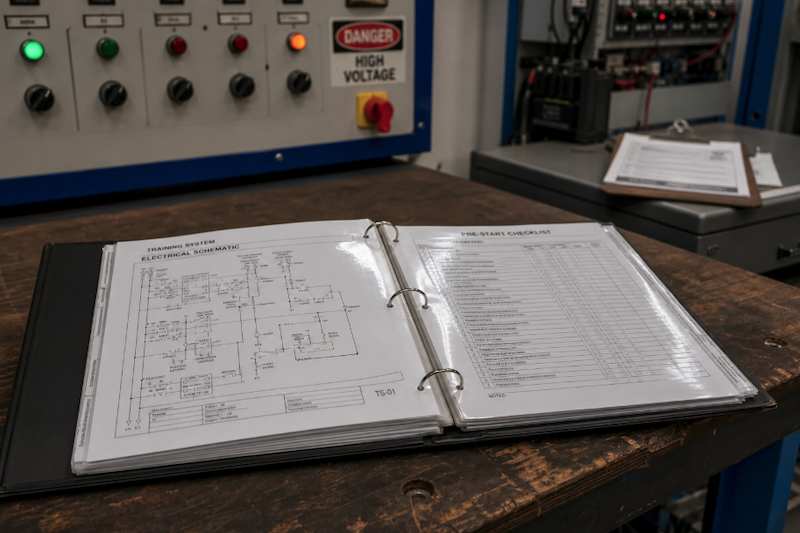
Documentation before sign-off requires physical accessibility to as-built electrical schematics, a PLC program backup with version notes, and detailed calibration records.
Lines that stall in month three almost always trace back to a gap in training, spares, or documentation rather than a mechanical fault in the equipment itself.
Pro Tip: Train operators on the line’s actual installed offsets and setpoints, not generic factory defaults. The day-one problems a new operator will face are exactly those real-world differences in configuration.
The Bottom Line
The project stages that slip are rarely the robotics phases. Timeline compression requires securing permitted heavy transport for over-dimensional loads and ensuring licensed electricians possess current code knowledge for complex panel terminations.
Site readiness and documentation completeness account for the remaining friction points in most facility upgrades. Identifying these specific logistical and compliance hurdles before signing the purchase order compresses the gap between capital approval and the first successful production run.
