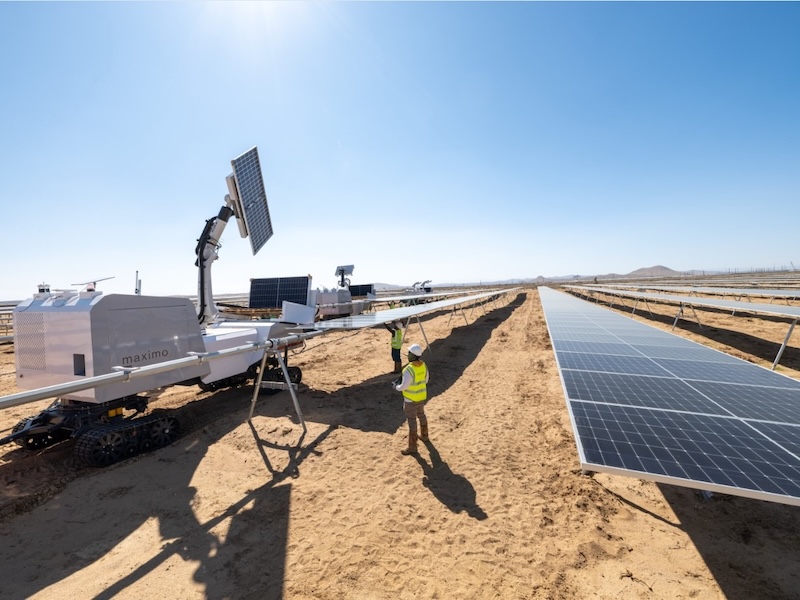
Maximo, the solar robotics company incubated by the AES Corporation, has announced the successful installation of 100 megawatts (MW) of utility-scale solar capacity at AES’ Bellefield complex, located on former agricultural land near California City in Kern County.
Demand for electricity continues to grow rapidly, driven by data center expansion, electrification and industrial manufacturing. Solar construction faces increasing pressure from labor constraints, compressed project timelines and cost volatility.
Maximo’s robotic solar installation solution is helping close the gap between the need for faster time to power and construction capacity. The 100 MW achievement marks the transition of robotic module installation from early deployment validation to sustained commercial production.
Chris Shelton, president of Maximo, says: “Reaching 100 MW at a single site is an important milestone for Maximo and for the role robotics can play in solar construction.
“It demonstrates that intelligent field robotics can deliver consistent results at utility scale. As solar deployment continues to accelerate globally, technologies that improve installation speed, quality and reliability will become increasingly important.”
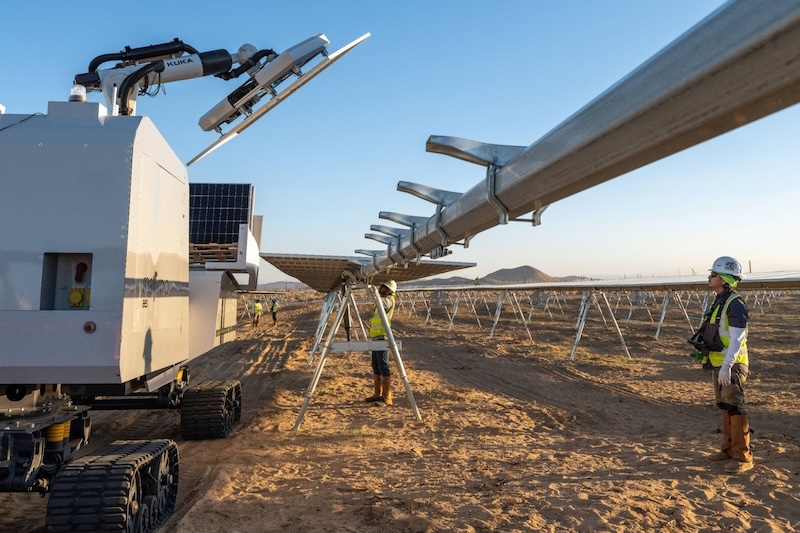
The Bellefield project scaled from a single robot to a coordinated fleet of four Maximo units operating in parallel. By tightly integrating robotic placement into standard construction workflows alongside skilled union technicians, the fleet delivered a step‑change in productivity while maintaining high safety and quality standards.
Maximo’s version 3.0 units’ technical performance rate consistently surpassed one module per minute, with crews installing as many as 24 modules per shift hour per person, nearly double the output of traditional installation methods in the region. The upcoming major release of Maximo version 4.0 builds on the industry leading scale and performance accomplished at Bellefield.
Nvidia technologies supported the development and readiness of the Maximo robotic fleet deployed in California. Leveraging Nvidia AI infrastructure together with Nvidia Omniverse libraries and Nvidia Isaac Sim open robotics simulation framework, the Maximo team was able to develop, test and refine robotic capabilities through physics-based simulation and AI driven modeling before deploying updates in the field.
The combination of AI, vision, robotics and simulation driven engineering reduced development and validation timelines and increased confidence in field performance as the robotic fleet scaled.
Marc Spieler, senior director of energy, Nvidia, says: “Physical AI is a powerful force for accelerating real world energy infrastructure. By combining AI infrastructure, simulation, and edge AI, platforms like Maximo demonstrate how physical AI can help accelerate solar panel installation while maintaining high reliability in complex environments.”
Amazon Web Services (AWS) powered the development, deployment, and operation of Maximo’s AI-driven field systems. AWS provides scalable computing, automated software delivery, and advanced data analytics, including real-time construction intelligence, enabling Maximo to collect operational robotics data and continuously improve performance.
Kara Hurst, chief sustainability officer, Amazon, says: “Innovation in carbon-free energy development is critical to meeting the world’s growing energy needs.
“By combining AI and robotics, technologies like Maximo demonstrate how we can accelerate the transition to carbon-free energy while improving safety and efficiency. Amazon is proud to support projects that push the boundaries of what’s possible in sustainable infrastructure.”
Utility-scale solar construction must expand rapidly to meet growing electricity demand, and the United States is expected to deploy hundreds of gigawatts of new solar capacity this decade.
Robotic installation solutions like Maximo allow Engineering, Procurement and Construction (EPC) firms to increase productivity, improve workforce safety and standardize installation quality while operating within complex construction environments.
Maximo says the Bellefield project installation demonstrates that robotics can now operate reliably at a gigawatt scale in solar construction.
