
Customer experience teams sit on ambitious goals – predict what users want, fix what frustrates them, and shape how they feel about a product.
Easy, right? Except not really. Because the moment teams try to understand how people behave outside their home market, everything gets complicated.
Geo-blocks. Limited visibility. Automated tools that get spotted and shut out.
Meanwhile, customers keep talking. They leave reviews, share opinions, rant on forums, praise on group chats. But unless your tools can see what those customers are actually saying – right there, in their own region and in their own words – you’re not hearing the full story.
So how do teams listen without getting kicked out of the room? With a smart mix of AI and residential proxies.

One Country’s Insight is Another’s Blind Spot
A product team in Sweden might think their checkout flow is seamless. But a shopper in Italy sees something completely different. The layout, payment options, even the language don’t match the intent behind the original design.
Most tools gather data from the most visible sources and treat it as if it tells the full story. But habits, preferences, and behavior shift across regions. When AI learns from just one slice, its results don’t always fit outside that narrow view. Strong results come from broad vision, not convenience.
What’s Actually Blocking the View?
There’s a long list of things standing between AI and the data it needs:
- Platforms that limit what you can see based on IP.
- Country-specific pages that look completely different depending on where you access them.
- Websites that serve one version to humans and another to anything that smells like a bot.
- APIs that politely show you the front porch but never let you in the house.
Residential proxies become that much needed window. They let AI tools move through digital spaces like everyday users. No red flags. No suspicion. Just smooth access to the version of the internet that people in that region actually see.
It doesn’t just help AI collect data. It helps it collect the right kind of data – the version shaped by culture, region, and language.
Where This Gets Really Useful
Let’s pause and break this into practical value. Here’s where teams start to see a difference:
1. Product Feedback Feeds That Actually Reflect Regional Behavior
Now you’re not reading reviews from one market and hoping they apply everywhere. You’re getting the real thing, as it happens.
2. Ad Performance Data That Makes Sense Locally
Your AI sees what the audience saw. Which ad ran, where it ran, how it was framed.
3. Search Behavior that Reflects Real-Time, Location-Specific Demand
Users in different countries search differently. Knowing that helps content teams and SEO planners stop guessing.
4. Customer Complaints That Don’t Take a Month to Show Up
Instead of waiting for aggregated reports, your team sees pain points unfolding in actual customer posts, within hours.
What AI Can Do When You Feed it the Right Signals
There’s a reason AI needs regional data – it doesn’t think in countries or languages. It only sees patterns. But if those patterns are built from filtered or limited data, the results are too smooth, too average, and oftentimes just too safe.
With rich, region-specific inputs, you get models that start to:
- Flag UX inconsistencies by market.
- Recommend content topics that match local interest.
- Suggest tone shifts in support communication.
- Predict churn more accurately based on cultural sentiment cues.
And the good news? This isn’t about retraining everything from scratch. It’s about feeding smarter data into the systems you already use.
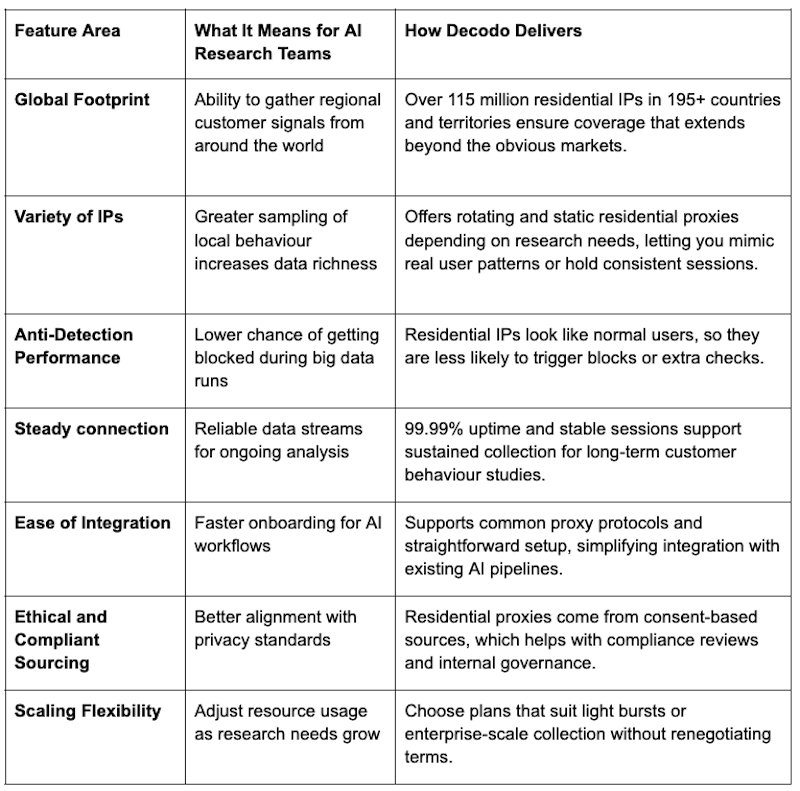
Why DECODO Works for This
No hard sell here. Just a practical fact: some proxy networks fall apart when AI workloads get serious. Some get blocked constantly. Others slow to a crawl under load. A few only cover major cities, leaving you flying blind in places that matter just as much.
Not Just More Data. More Honest Data
A spike in support tickets. A drop in mobile app ratings. A sudden shift in what people are searching for on your site. AI can catch all of these, but only if it’s watching the right screens.
Residential proxies don’t give you secret powers. They just take away the restrictions that were keeping your tools from seeing the full picture. For customer experience teams, that shift changes everything. Now research isn’t just fast – it’s complete.
