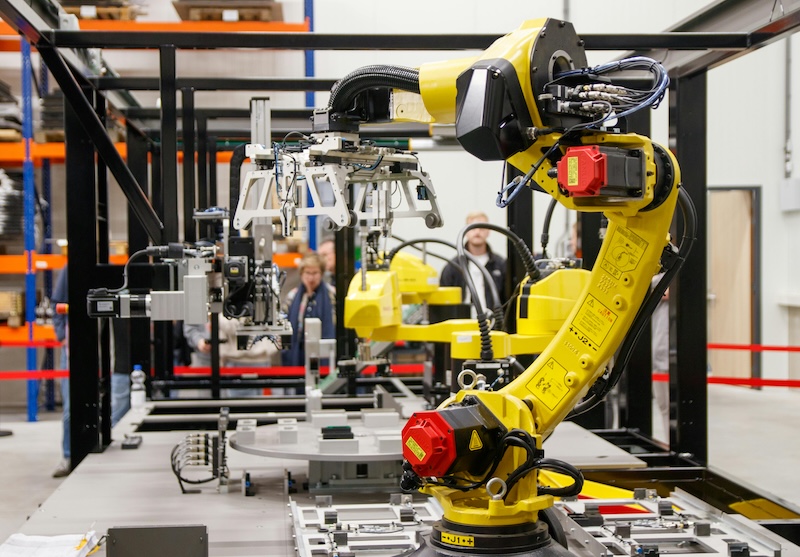
Automation strategy usually centers on robotics, AI inspection systems, and synchronized production lines. Yet every automated facility depends on utilities that must perform with the same precision as the machines they support. Industrial water treatment is one of the most critical of these systems.
In advanced manufacturing, water is not a background service. It directly affects heat exchange efficiency, chemical balance, surface treatment quality, and equipment lifespan. As plants push toward higher levels of autonomy, water infrastructure must meet the same standards of monitoring and integration.
Water as a Controlled Process Variable
Semiconductor fabrication, pharmaceutical production, food processing, and advanced materials manufacturing require strict water specifications. Dissolved solids, scaling potential, and biological contaminants directly influence production stability and product quality.
In tightly synchronized environments, even minor deviations can trigger shutdowns across interconnected processes. Automated systems do not tolerate variability well. Stabilizing input conditions becomes essential to maintaining uptime and protecting capital equipment.
Industrial reverse osmosis systems remove dissolved salts and impurities, creating consistent permeate quality. That consistency protects boilers, cooling loops, and direct process applications operating within automated production lines.
From Mechanical Utility to Integrated Asset
Water treatment systems were once managed primarily through manual inspection and scheduled service. Operators tracked pressure drops and conductivity levels, responding after efficiency declined.
Modern installations function differently. Sensors continuously measure differential pressure, recovery rates, pump performance, and permeate conductivity. These data streams feed directly into PLCs and plant-wide SCADA platforms.
The shift changes how utilities are viewed. Water systems are no longer passive mechanical infrastructure. They operate as monitored assets within the same control environment that governs robotics and motion systems.
Automation Integration and Control Alignment
Smart manufacturing depends on interoperability. Utilities must respond dynamically to changes in production demand rather than operate independently from plant controls. Reverse osmosis systems now include programmable recovery thresholds, automated flush cycles, and real-time diagnostics.
When production output increases, treated water capacity must scale immediately. A plant expanding overnight shifts cannot rely on manual adjustments. System alignment is often executed in coordination with EAI Water to ensure reverse osmosis controls communicate directly with existing PLC and SCADA architectures.
This level of integration positions water treatment inside the automation framework rather than outside of it. It becomes a synchronized component of plant operations.
Predictive Maintenance for Water Infrastructure
Predictive maintenance is standard practice for robotics and rotating equipment. The same methodology applies to filtration membranes and high-pressure pumps. Water infrastructure generates measurable performance signals before failure occurs.
Rising differential pressure across membranes indicates fouling. Shifts in conductivity trends signal declining rejection efficiency. Increased energy draw per gallon treated may reveal scaling buildup or pump wear.
When this data is integrated into centralized dashboards, maintenance shifts from reactive repair to performance-based planning. In high-output facilities, preventing one unplanned interruption can justify the investment in continuous monitoring.
Energy and Efficiency Metrics
Automation platforms increasingly track energy intensity and resource efficiency. Water treatment contributes directly to these metrics: pump load, membrane condition, and recovery rate influence total energy consumption per unit of output.
Automated control logic maintains optimal operating pressure without excess energy draw. Adjusting recovery rates in response to feedwater conditions reduces waste while preserving membrane life.
Continuous monitoring provides actionable performance data rather than periodic estimates. Water systems, therefore, support both operational efficiency and sustainability targets in automated environments.
Scalability and Production Agility
Automated facilities are designed for phased expansion. Robotics platforms are modular, allowing incremental increases in throughput without full redesigns. Utility infrastructure must support the same flexibility.
Modular reverse osmosis skids and expandable membrane arrays enable capacity growth alongside automation upgrades. This prevents water treatment from becoming a constraint during production scaling.
If utilities cannot expand in parallel with robotics deployment, operational agility suffers. When engineered for modular growth, water infrastructure reinforces a long-term automation strategy.
Expanding the Definition of Automation
Automation discussions often focus on visible technologies. Robotic arms, AGVs, and AI inspection systems dominate industry coverage. These systems, however, depend on stable utilities operating within strict parameters.
Industrial water treatment now functions within the same architecture of sensors, analytics, and programmable control logic that defines smart manufacturing. It protects equipment, stabilizes process inputs, and supports consistent production output.
As factories pursue greater autonomy, every system influencing quality and uptime must be measurable and integrated. Water infrastructure has crossed that threshold. It is no longer background support. It is part of the automation layer itself.
Main image by Freek Wolsink, Pexels
