When Nidec Drives Africa was approached to design a Variable Frequency Drive (VFD) Motor Control Centre (MCC) for the new “SL1A” Ship Loader at Dalrymple Bay Terminal in Mackay, Australia, the task was clear – but far from simple.
The goal was to modernise offshore operations nearly 4 kilometres out to sea, enhancing efficiency and embedding advanced redundancy into a system that had long relied on outdated technology.
A challenge beyond the shoreline
The existing infrastructure lacked the redundancy and safety features required for modern industrial operations. Positioned offshore, the SL1A Ship Loader faced unique challenges – chief among them, managing up to 1 MW of regenerative energy while connected to the 415Vac Australian electrical grid.
The system also needed to automatically reconfigure its 1 MW regenerative Active Front End (AFE) MCC power circuits into an Active DC-Bus configuration.
This would enable dynamic braking when the ship loader switched to its alternative diesel generator power source. And with the inherent risks of such a high-power application, every safety circuit had to meet the rigorous Safety Integrity Level 3 (SIL 3) standards.
Designing the solution: Precision meets innovation
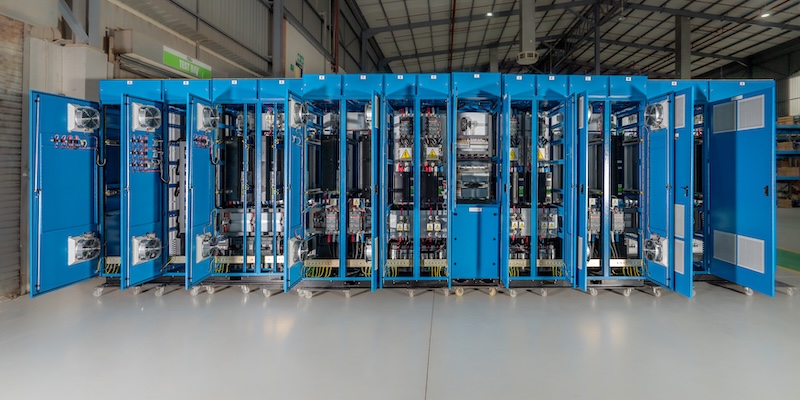
Over an intense 18-week design and build period, the Nidec team engineered a robust, IP44-rated MCC built to “Form 4a” construction standards. The system features:
A centrally located incomer busbar section will accommodate the main 3-phase, 415 Vac supply, including a raw 3-phase, 415 Vac supply with neutral connection.
Dedicated sections will also be provided for 24 Vdc and 48 Vdc small power systems, along with overhead busbar chambers for 600 Vdc at 1800 Amps.
Six segregated MCC shipping sections, including 2 x AFE units and a suite of motoring VFDs.
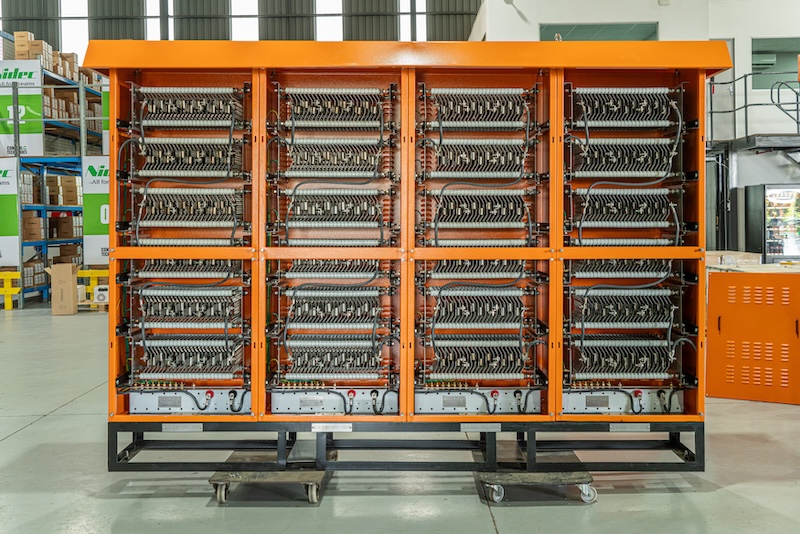
The entire assembly measured 8600 mm x 800 mm x 2400 mm and weighed in at approximately 8.2 tonnes – including external dynamic braking resistors.
To ensure ease of maintenance, each VFD power unit was mounted on heavy-duty, withdrawable sliders. Operators can access door-mounted controls and remote keypads for real-time diagnostics and operational data per cubicle.
The system was powered by Control Techniques’ M702 VFDs, each equipped with dual Safe Torque Off (STO) functionality, ensuring full SIL 3 compliance. All communications were streamlined via Ethernet /IP.
The payoff: safety, efficiency, and scalability
The result was a custom-engineered MCC that delivered on every front:
- Enhanced safety: Dual STO features and SIL 3 compliance significantly reduced electrical hazards.
- Improved efficiency: Seamless reconfiguration between power sources optimised energy use and performance.
- Ease of maintenance: Withdrawable sliders and accessible controls minimised downtime.
- Scalability: The modular design allowed for future upgrades with minimal disruption.
A system built for complexity
The MCC supported a wide range of applications, each critical to the ship loader’s operation:
- Dual Active Front End (AFE1 and AFE2) VFDs (Multi-Master/Follower)
- Alternative Active DC-Bus system when operating via diesel generator power source
- Dual Boom Luff Winch (BLW1 and BLW2) VFDs (Multi-Master/Slave)
- Long Travel VFDs (LT1, LT2, LT3)
- Boom Shuttle Winch (BSW) VFD
- Tele Chute Winch (TCW1 and TCW2) VFDs
- Hose and Cable Reel (CR and HR) VFDs
This project stands as a testament to what’s possible when engineering precision meets real-world complexity. Nidec Drives Africa didn’t just deliver a solution – they redefined what’s possible for offshore industrial automation.
