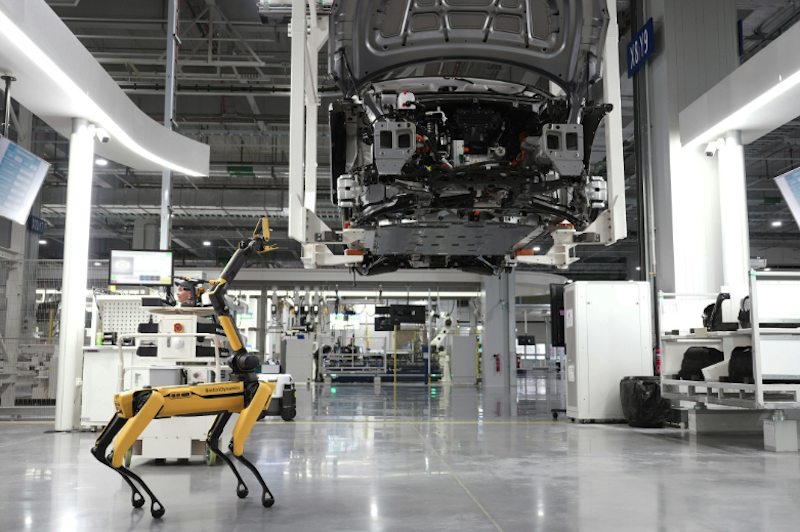
While digital asset charts cool off, factory floors are receiving a massive influx of capital. Venture firms are swapping volatile tokens for robots that demonstrate tangible utility. The following analysis details the financial pivot toward physical automation in healthcare and manufacturing.
2025 proved that utility is the ultimate value driver. While speculative assets experienced natural market cycles, a quiet, substantial shift occurred in venture capital boardrooms. Fund managers moved focus from viral tokens to hardware that solves real-world problems.
The experts aren’t just talking about prototypes anymore. Capital is flooding into systems that can hold a scalpel or assemble a gearbox. Funding is backing machines that build, rather than just code that counts.
Volatility in crypto markets fails to dampen manufacturing investment enthusiasm
Market data shows the Ethereum price opened 2025 near $3,331 before a wave of mid-year activity sent charts upward. By August, the asset rallied past $4,600 according to data from Binance. Valuations settled around $2,966 by December 31. November data showed a 15.43% month-on-month adjustment in total market capitalization.
Such fluctuations did not deter industrial capital deployment. Crunchbase numbers indicate that global venture funding hit $425 billion in 2025.
A staggering $211 billion went straight into AI. Investors are prioritizing “frontier physical AI”. Allocators are favoring utility. If a startup tackles labor shortages with hardware, the checkbook is open. Manufacturing creates necessary value, driving the capital rotation seen last year.
Swiss spinout secures major funding to bridge labor gaps with physical AI
Mimic Robotics, an ETH Zurich spinout, solidified the hardware thesis on November 3, 2025, by securing a fresh $16 million seed round. Elaia and Speedinvest led the deal, with Founderful, 2100 Ventures, and the Sequoia Scout Fund participating.
Total funding now sits north of $20 million. Most engineers spend years attempting to build full humanoids. Mimic builds better hands for the robots that are already available. They retrofit standard industrial arms with dexterous end-effectors powered by imitation learning.
Teaching a robot to handle a fragile object usually requires months of coding. Mimic skips that. Workers wear data-collection gear, demonstrating the task once. Algorithms watch, learn, and repeat.
Such an approach solves the “data scarcity” problem immediately. Fortune 500 logistics firms are already running pilots to automate tasks that previously required human thumbs. Deploying these systems offers a practical fix for the labor crunch that doesn’t require bulldozing the factory.
Medical robotics breakthroughs offer new pathways for targeted healthcare delivery
ETH Zurich researchers achieved a significant milestone on November 14, 2025. Researchers revealed a magnet-controlled microrobot built to swim through arteries. It functions as a tiny spherical capsule packed with iron oxide nanoparticles for steering and tantalum so surgeons can track it on X-rays.
Navigating against the laminar or turbulent characteristics of blood flow presents a complex challenge within the realm of fluid dynamics. This involves considering factors such as rheology, shear stress, and the impact of vessel geometry on flow resistance.
Yet, the bot manages speeds up to 4mm per second. A study published in Science confirmed it hit a 95% success rate in pig trials.
The primary missions focus on stroke treatment. Currently, busting a clot often means flooding a patient with systemic drugs like tPA, which risks bleeding elsewhere.
Robotic precision delivers the payload directly to the blockage. Precision saves tissue. The industry is facing a future where machines physically travel to the injury site. That kind of technology turns a high-risk systemic procedure into a targeted mechanical solution.
External magnetic fields steer these micro-swimmers through complex arterial networks. Surgeons control the path from a console while real-time imaging tracks every movement.
Recovery times drop significantly when healthy cells escape exposure to potent chemicals. Engineering at this scale provides control previously impossible in neurology.
Institutional demand and market outlook for the coming year
Industrial automation needs a payment layer that can keep up. That arrived on December 3, 2025, with the Ethereum “Fusaka” upgrade.
Developers merged the Fulu consensus fork with the Osaka execution fork to deploy PeerDAS and Blob-Parameter-Only improvements. Results indicate a 40-60% drop in Layer 2 transaction costs. Machine-to-machine payments finally make economic sense at high volume.
SB Seker, Head of APAC at Binance, points out that “2025 demonstrated that crypto platforms are now being assessed as financial infrastructure, not just technology platforms”.
Findings in the “State of the Blockchain 2025” report back him up: Binance cleared $34 trillion in volume and crossed 300 million users. Institutional players are finally getting the volume and security they demanded.
Statutes are hardening right alongside the software. ADGM regulations provide a pretty clear sandbox for Decentralized Financial AI (DeFAI) to exit the theoretical phase.
Concepts are moving fast toward real-world application. Trust effectively becomes infrastructure in 2026. Autonomous machines will handle transactions themselves, settling operations directly on-chain with full legal backing.
However, paths in the sector are forking. Day traders stare at charts while the industrial complex undergoes a quiet overhaul (mostly unnoticed). Asset value now relies on physical utility rather than just execution speed. Capital is flooding into robotics as these machines move from prototypes to production lines.
