Automation systems are increasingly defined by their ability to operate continuously, predictably, and at scale.
As robotics platforms, control software, and AI-driven decision layers mature, many manufacturers are discovering that system-level performance is no longer limited by algorithms or sensors, but by the physical materials that sit quietly between machines and processes.
In high-duty automation environments, material stability is emerging as a critical bottleneck that directly affects uptime, data reliability, and long-term operational efficiency.
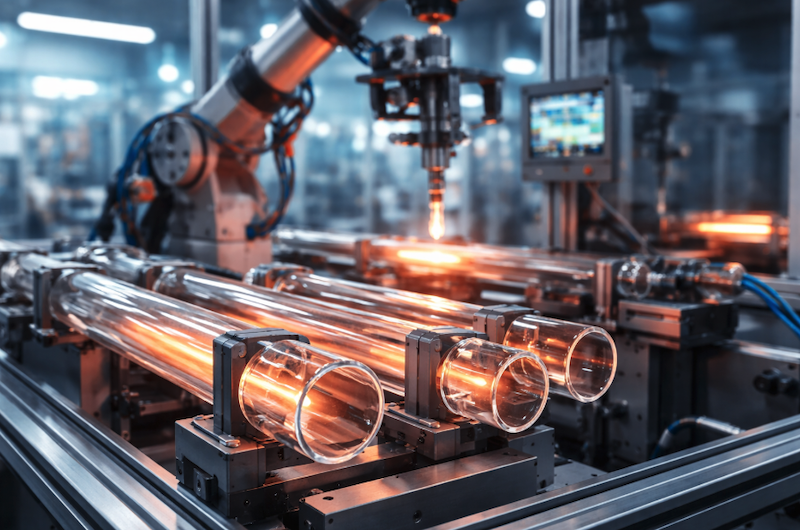
In thermal-intensive and optically sensitive automation systems, components such as fused quartz tubes serving as dimensionally stable interfaces in automated thermal systems play a foundational role.
These passive elements are not responsible for control or computation, yet their mechanical and thermal behavior directly influences whether automated systems can maintain consistent performance over extended operating cycles.
As automation expands beyond isolated cells into continuous, networked production environments, the tolerance for material-induced drift, deformation, or degradation has narrowed dramatically.
Automation Has Outpaced Traditional Material Assumptions
For decades, industrial automation design focused on repeatability at the machine level. Robots executed predefined paths, sensors collected discrete signals, and maintenance schedules assumed periodic intervention. Materials were selected primarily for strength and basic heat resistance, often with generous safety margins.
Modern automation environments operate under fundamentally different constraints. Systems now run continuously, adapt dynamically, and generate high-frequency data streams that feed predictive analytics and AI models. Under these conditions, even minor material instabilities can propagate into measurable system-level errors.
Thermal expansion, surface devitrification, chemical interaction, and long-term dimensional creep are no longer secondary considerations.
When automation lines depend on precise alignment, optical clarity, or thermal isolation, the cumulative effects of material behavior over thousands of operating hours become impossible to ignore.
The Hidden Cost of Passive Component Drift
In many automated systems, passive components are assumed to be static. Tubes, housings, windows, and containment elements are expected to maintain their geometry and properties indefinitely, provided operating conditions remain within nominal limits.
In practice, automated environments expose materials to combined stresses that traditional qualification models rarely capture. Repeated thermal cycling, localized hotspots, UV exposure, and reactive atmospheres can gradually alter material properties without causing immediate failure.
The result is not catastrophic breakdown, but subtle drift:
- Optical paths lose alignment or transmission consistency
- Sensor interfaces experience baseline shifts
- Thermal gradients change heat transfer behavior
- Mechanical tolerances tighten unpredictably
These effects are difficult to diagnose because they emerge slowly and often masquerade as sensor noise, calibration errors, or control instability.
Why System-Level Reliability Depends on Material Consistency
Automation platforms are increasingly evaluated on uptime, yield stability, and data integrity rather than raw throughput alone. In this context, material consistency becomes a system-level reliability parameter.
When automated systems integrate robotics, sensing, heating, and data processing into a closed loop, every physical interface must behave predictably.
A component that performs well in isolation but exhibits variability over time can undermine the reliability of the entire system.
This is particularly evident in automation environments that operate at elevated temperatures or require precise thermal management. Interfaces that experience repeated heating and cooling cycles must maintain dimensional stability to prevent stress accumulation and misalignment.
In such workflows, supporting components like quartz crucibles used for controlled material handling in high-temperature automation workflows are selected not for visibility, but for their ability to remain inert, stable, and repeatable under sustained thermal load.
Their role is to ensure that process conditions remain controlled, even as automated systems scale and operate continuously.
Material Stability as an Enabler of Predictive Maintenance
Predictive maintenance relies on the assumption that deviations in system behavior reflect changes in machine condition, not unpredictable material responses. When materials introduce variability, data-driven maintenance models lose accuracy.
Automation systems that incorporate stable materials at critical interfaces generate cleaner, more interpretable data. Temperature readings remain comparable over time, optical signals retain consistent baselines, and mechanical tolerances do not drift unpredictably.
This stability allows maintenance algorithms to detect genuine anomalies rather than compensating for gradual material-induced shifts. In effect, material stability acts as a noise-reduction layer for industrial data systems.
As manufacturers adopt AI-assisted maintenance strategies, the value of predictable material behavior increases. Stable materials reduce false positives, improve fault isolation, and extend the usable life of both hardware and analytics models.
Designing Automation Systems for Long-Term Operation
The shift toward lights-out manufacturing and autonomous operation has elevated the importance of long-term material performance. Systems are now expected to operate for months with minimal human intervention, often in environments that are thermally or chemically aggressive.
Designing for these conditions requires a departure from short-term performance metrics. Materials must be evaluated not only for initial properties, but for how those properties evolve over time under real operating conditions.
Engineering teams are increasingly integrating material selection into early-stage system architecture decisions. Rather than treating materials as interchangeable consumables, they are assessed as integral components of system reliability.
Material Stability as a Strategic Constraint
As automation systems grow more complex and interconnected, the weakest link often lies in the most unassuming components. While software and robotics continue to advance rapidly, material behavior follows physical laws that cannot be optimized through code alone.
Material stability has become a strategic constraint on automation performance. Systems that fail to account for long-term material behavior risk accumulating inefficiencies that erode the benefits of advanced control and analytics.
Conversely, automation platforms built on stable, well-characterized materials gain a quiet advantage. They deliver more consistent data, require fewer corrective interventions, and maintain alignment between digital models and physical reality.
Conclusion
The next phase of industrial automation will not be defined solely by smarter algorithms or faster robots. It will be shaped by how effectively physical systems maintain stability over time.
Material stability is no longer a background consideration. It is a prerequisite for reliable automation at scale.
As manufacturers push toward continuous operation, predictive maintenance, and AI-driven control, the materials that form the physical backbone of these systems will increasingly determine whether automation delivers on its promise – or encounters its next bottleneck.
