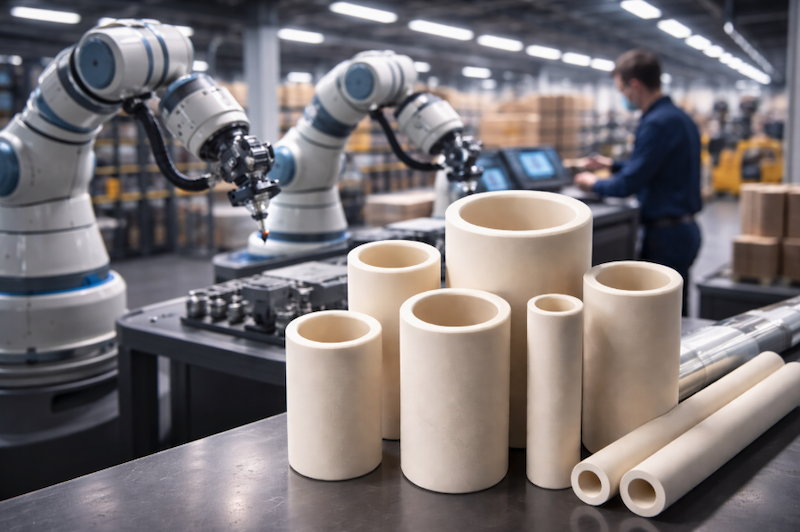
Collaborative robots, commonly known as cobots, are reshaping how factories think about automation. Unlike traditional industrial robots that operate in isolated cells, cobots are designed to work safely alongside humans, sharing tasks, spaces, and workflows.
This shift is driven by the need for flexibility, rapid reconfiguration, and higher precision in increasingly complex manufacturing environments.
As cobots take on more delicate and variable tasks, system stability becomes critical. Small deviations in positioning, thermal expansion, or structural alignment can directly affect accuracy and repeatability.
For this reason, manufacturers are paying closer attention to the materials used in cobot assemblies and peripheral systems, including alumina ceramic tubes supporting thermal and positional stability in collaborative robotic systems that help maintain consistent performance under continuous operation.
The evolution of human-robot collaboration is therefore not only a software or safety story, but also a materials and engineering challenge that sits at the foundation of reliable automation.
Why Human-Robot Collaboration Demands Higher Precision
Cobots are often deployed in tasks such as assembly, inspection, machine tending, and quality control – applications where precision matters as much as safety. Unlike fully automated lines, these environments involve frequent human interaction, manual adjustments, and changing task parameters.
This variability places additional stress on mechanical and structural components. Repeated start-stop cycles, localized heat generation, and constant micro-adjustments can gradually affect alignment and positioning.
Over time, even minor material instability can lead to reduced accuracy, increased recalibration frequency, or unplanned downtime.
To support effective collaboration, cobot systems must deliver predictable, repeatable motion while tolerating real-world operating conditions. This requirement elevates the importance of material choices within joints, housings, supports, and sensor interfaces.
Material Stability as a Foundation for Reliable Cobots
Advanced ceramics, particularly alumina-based materials, are increasingly evaluated for use in precision-critical robotic components. Their low thermal expansion, electrical insulation properties, and resistance to wear make them suitable for environments where consistency is essential.
In collaborative robotic assemblies, high-purity alumina ceramic rods used in precision-guided cobot assemblies can serve as structural or alignment elements that help preserve geometry over long operating cycles.
By reducing deformation and wear, such components contribute to stable motion paths and reliable sensor positioning.
Rather than replacing metals across entire systems, these materials are typically applied in targeted roles where their properties address specific failure modes or performance limitations.
Supporting Safety and Efficiency Through Engineering Choices
Safety is a defining characteristic of collaborative robots. Force-limiting mechanisms, advanced sensing, and responsive control systems all depend on accurate feedback from the physical system. When structural components shift or degrade, safety margins can narrow unexpectedly.
Material stability supports safety indirectly by ensuring that the assumptions built into control algorithms remain valid. When physical behavior aligns with modeled behavior, cobots can react more predictably to human presence and interaction.
At the same time, stable materials reduce maintenance requirements and calibration drift, allowing production teams to focus on process improvement rather than constant adjustment.
The Future of Human-Robot Teams in Smart Manufacturing
As factories move toward higher product mix, shorter production runs, and greater customization, collaborative robots will play an increasingly central role. Their success will depend not only on intelligent software and intuitive interfaces, but also on robust physical design.
Looking ahead, manufacturers are likely to integrate material considerations earlier in the cobot design and deployment process. By aligning material performance with operational demands, human-robot teams can achieve higher levels of precision, reliability, and trust on the factory floor.
In this way, the rise of collaborative robots highlights a broader trend in automation: true intelligence emerges when digital control and physical stability evolve together.
