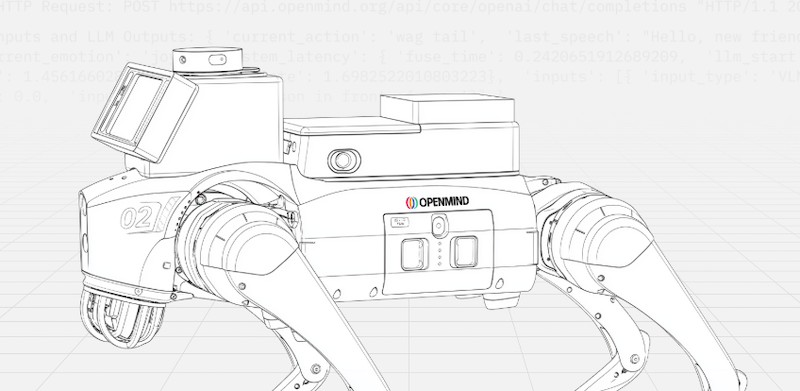
OpenMind, a robotics software company, has launched its “App Store for robots”, a platform designed to serve as the software distribution layer for quadruped and humanoid robots already operating in real-world environments.
As robots move beyond research labs into commercial and consumer deployment, software – not hardware – has emerged as the primary constraint on scale. While robotic platforms continue to mature mechanically, most remain locked into vertically integrated software stacks that limit adaptability and slow iteration.
OpenMind’s App Store introduces a shared application marketplace that allows robots to be configured, updated, and repurposed through software.
Jan Liphardt, founder and CEO of OpenMind, says: “Computers and phones come with an operating system to provide the basics, but the real magic is the ability for everyone to personalize their phones and computers through apps and programs. That’s how generic hardware comes to life and becomes your phone and your laptop.
“Your humanoid will be no different – thousands of apps, each representing skills from nursing and math education to cleaning and home safety, will give you almost unlimited choices. There won’t be one robot that works everywhere.
“Robots need a skill and cognition layer that evolves faster than hardware. The App Store is how robots become universal platforms whose skills can change over time to fit your needs.”
The OpenMind App Store enables developers to publish robotic applications and allows robot operators to deploy new capabilities to their machines without custom integration. The first application went live this week, and the platform is now open globally to developers and robotics companies.
At launch, the App Store supports deployment across robots from ten different hardware manufacturers and includes five live applications. Built by the OpenMind team, the first applications released to the App Store focus on autonomous movement, social, and privacy.
The platform is built on OM1, OpenMind’s modular operating system for social and autonomous robots. OM1 allows models, behaviors, and task logic to be defined through lightweight configuration files, enabling developers to package complex capabilities into portable applications that can be distributed and updated at scale across heterogeneous hardware.
OpenMind is launching the App Store with a group of launch partners comprising some of the most established robotics manufacturers in the industry – companies with existing deployments, commercial customers, and operational presence across education, logistics, inspection, healthcare, and public environments. Launch partners include Ubtech, Agibot, Deep Robotics, Fourier, Booster, Dobot, LimX, and Magic Lab.
These companies are collaborating with OpenMind to enable early platform support and to help define shared interfaces and standards for robotic applications.
Launch partners will be featured on the App Store, participate in joint promotion, and take part in a founding consortium shaping the platform’s roadmap.
The first in-person consortium meeting will take place in April near the Stanford University campus.
OpenMind said its developer ecosystem already includes more than 1,000 developers worldwide and is now open to additional developers and robotics companies seeking to build, publish, or deploy applications through the App Store.
