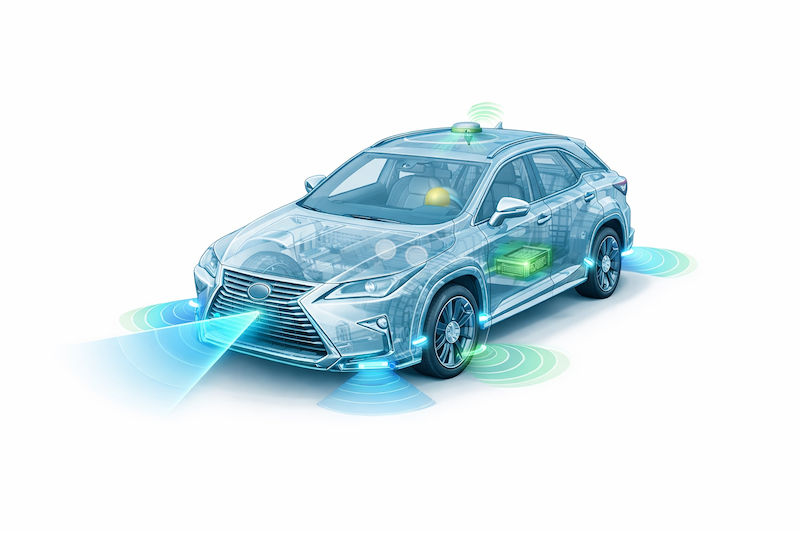
How perception technologies work together to enable machine autonomy
Autonomous vehicles are often described in terms of intelligence, decision-making, or artificial intelligence. In practice, however, autonomy rises or falls on a more fundamental capability: perception.
A vehicle that cannot reliably perceive its environment cannot make safe decisions, regardless of how advanced its planning software may be.
Perception is the process by which an autonomous system detects objects, understands spatial relationships, tracks motion, and anticipates change. It is not a single function, nor is it delivered by a single sensor.
Instead, perception emerges from a tightly integrated suite of sensors – most commonly cameras, LiDAR, and radar – combined through software-based sensor fusion.
This sensor suite forms the foundation of autonomy across road vehicles, trucks, industrial machines, and mobile robots. Understanding how these technologies work together is essential to understanding why large-scale autonomy remains difficult, slow to deploy, and highly context-dependent.
Perception as the real autonomy problem
Public discussions around autonomous vehicles often focus on whether machines can “drive themselves”. Engineers tend to frame the challenge differently. Before a vehicle can plan or act, it must first answer three questions with high confidence:
- What is around me?
- How is it moving?
- What is likely to happen next?
These questions correspond to detection, tracking, and prediction. Unlike human perception, which is adaptive and context-driven, machine perception is statistical. Every sensor measurement carries uncertainty, noise, and the possibility of failure.
This is why perception is often described as the bottleneck of autonomy. Errors at this stage propagate through the system. A missed detection, a misclassified object, or a delayed update can all lead to unsafe decisions downstream.
No individual sensor can meet the full set of perception requirements under all conditions. The modern autonomous vehicle therefore relies on a heterogeneous sensor suite, designed to balance strengths and weaknesses.
Cameras: Semantic richness with fragile certainty
Cameras are the most intuitive perception sensor because they resemble human vision. They capture high-resolution visual information, including colour, texture, text, and shape. This makes them particularly effective for understanding semantics – lane markings, traffic signs, signals, and object classes.
Advances in computer vision and deep learning have dramatically improved the ability of camera-based systems to detect and classify objects. Neural networks trained on large datasets can identify vehicles, pedestrians, cyclists, and road features with impressive accuracy under favourable conditions.
However, cameras have inherent limitations. They do not directly measure depth unless used in stereo configurations or combined with motion cues.
Their performance degrades significantly in low light, glare, fog, rain, snow, or dust. Shadows and reflections can introduce ambiguity, while occlusions can obscure critical objects.
From a safety perspective, cameras are information-rich but fragile. They excel at contextual understanding but struggle with reliability under adverse conditions. This makes them indispensable but insufficient on their own for safety-critical autonomy.
LiDAR: Geometry, distance, and spatial certainty
LiDAR addresses many of the shortcomings of cameras by directly measuring distance. By emitting laser pulses and measuring their return time, LiDAR sensors generate precise three-dimensional point clouds representing the geometry of the environment.
This geometric accuracy makes LiDAR particularly valuable for object separation, free-space detection, and localisation. LiDAR does not rely on ambient light, and it provides consistent depth information regardless of texture or colour. As a result, LiDAR is often treated as a source of spatial ground truth within the perception stack.
The limitations of LiDAR are primarily practical rather than conceptual. LiDAR sensors are more complex and expensive than cameras, although costs have fallen substantially. Performance can degrade in heavy rain, fog, or dust, where laser pulses are scattered or absorbed. Mechanical LiDAR systems also introduce durability and maintenance considerations.
Despite these challenges, LiDAR remains central to most high-level autonomous vehicle programs, particularly in applications where safety margins must be explicit and measurable.
Radar: Robustness and motion awareness
Radar occupies a different position in the sensor suite. Automotive radar systems operate at radio frequencies and are highly effective at measuring range and relative velocity. They perform reliably in conditions that challenge optical sensors, including rain, fog, snow, and darkness.
Radar’s ability to directly measure Doppler velocity makes it especially valuable for tracking fast-moving objects and estimating closing speeds. This capability is difficult to replicate with cameras or LiDAR alone.
The trade-off is resolution. Traditional automotive radar has relatively low angular resolution, making it harder to distinguish closely spaced objects or to classify them accurately. Advances in high-resolution and imaging radar are improving this limitation, but radar remains less semantically informative than vision-based sensors.
In the sensor suite, radar acts as a stabilising layer. It provides robust, physics-based measurements that anchor perception under adverse conditions, even when other sensors degrade.
Ultrasonic and auxiliary sensors: Small signals, big impact
Beyond the primary sensors, autonomous vehicles rely on a range of auxiliary sensing technologies. Ultrasonic sensors provide reliable short-range detection for parking and low-speed manoeuvres. Inertial measurement units (IMUs), wheel encoders, and GNSS receivers support localisation and motion estimation.
These sensors are often overlooked in discussions of autonomy, yet they play a critical role in system stability. Accurate motion estimation, sensor synchronisation, and redundancy all depend on these supporting inputs.
Autonomy is not achieved by adding one breakthrough sensor. It emerges from careful integration of many modest components, each contributing incremental reliability.
Sensor fusion: Where perception actually happens
While individual sensors provide partial views of the environment, perception emerges through sensor fusion. Fusion is the process of combining data from multiple sensors to produce a more accurate, robust, and consistent representation of the world.
Fusion can occur at multiple levels. Early or raw-data fusion combines sensor measurements before interpretation, enabling precise geometric alignment but requiring high bandwidth and tight synchronisation.
Feature-level fusion combines extracted features such as object detections or tracks. Decision-level fusion combines higher-level outputs, such as classifications or behavioural predictions.
Each approach involves trade-offs. Early fusion offers maximum information but high computational cost. Late fusion is more modular but can propagate inconsistencies. Most production systems use hybrid architectures, balancing accuracy, latency, and reliability.
Crucially, sensor fusion is not just about combining signals. It involves probabilistic modelling, confidence estimation, and temporal reasoning. The system must decide not only what it sees, but how certain it is – and how that certainty evolves over time.
The perception stack: Hardware, software, and compute
Modern perception systems sit at the intersection of hardware and software. Sensors generate large volumes of data that must be processed in real time, often within strict latency budgets. This has driven the development of specialised compute platforms, including GPUs, AI accelerators, and dedicated perception processors.
Timing and synchronisation are as important as raw performance. Sensor data must be aligned in time and space to avoid inconsistencies. Even small delays can lead to significant errors at highway speeds.
Power consumption and thermal management further constrain system design, particularly in electric vehicles and compact platforms. Perception systems must deliver high reliability within tight energy budgets.
Edge cases, failure modes, and redundancy
One of the defining challenges of autonomous perception is the dominance of edge cases. Rare events – unusual objects, unexpected behaviours, degraded sensors – account for a disproportionate share of risk.
As a result, perception systems are designed with redundancy in mind. Redundancy is not merely a backup mechanism; it is a core design principle. Diverse sensors provide overlapping coverage, reducing the likelihood of common-mode failures.
Equally important is graceful degradation. When sensor performance degrades, the system must recognise the limitation and adjust behaviour accordingly, rather than continuing with false confidence.
Automotive and industrial autonomy: Shared principles, different constraints
While this discussion often centres on road vehicles, the same perception principles apply across autonomous systems. Industrial vehicles, mining equipment, and port machinery all rely on sensor suites and fusion architectures.
The difference lies in operational constraints. Industrial environments are often more structured and controlled, allowing perception systems to be simplified. Automotive environments are open, unpredictable, and socially complex, demanding far greater robustness.
Despite these differences, advances in one domain frequently transfer to others. Improvements in radar resolution, LiDAR cost, or fusion algorithms benefit autonomy across sectors.
Economics and platform strategy
Sensor choice is not purely technical; it is economic. Cameras are inexpensive but computationally demanding. LiDAR adds cost but reduces uncertainty. Radar offers robustness with limited semantic detail.
Manufacturers must balance hardware costs against software complexity, validation effort, and long-term reliability. Increasingly, perception stacks are becoming platforms in their own right, defining competitive advantage and shaping supplier ecosystems.
Vertical integration offers control and optimisation, while modular approaches offer flexibility and faster iteration. There is no single winning strategy, only trade-offs aligned with specific use cases.
Autonomy as a systems problem
Autonomous vehicles are not enabled by a single breakthrough sensor or algorithm. They are enabled by carefully engineered systems that combine diverse sensors, robust fusion, and disciplined design.
Perception remains the gating factor for autonomy at scale because the real world is complex, uncertain, and unforgiving. Cameras, LiDAR, radar, and auxiliary sensors each contribute essential capabilities, but none can succeed alone.
As autonomous systems expand beyond passenger cars into freight, logistics, and industrial infrastructure, the lesson becomes clearer: autonomy is not about replacing human intelligence with machine intelligence. It is about building systems that perceive the world reliably enough to act within it.
