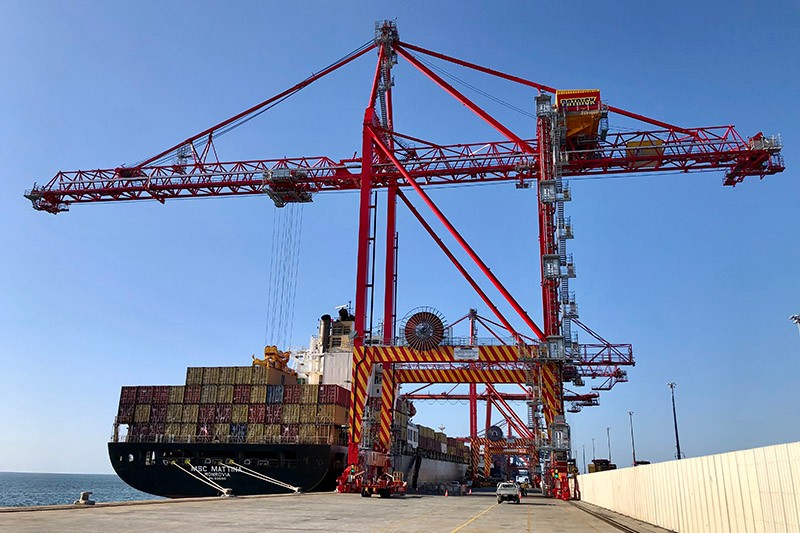
Autonomous straddle carriers, cranes, and internal terminal vehicles
Ports are among the most automated industrial environments in the world – yet they remain largely invisible in discussions about robotics and autonomy.
While factories and warehouses dominate headlines, container terminals quietly operate as vast cyber-physical systems, coordinating fleets of machines that move the physical foundations of global trade.
A modern container port is not a single robot or even a fleet of robots. It is an integrated system of cranes, vehicles, sensors, software platforms, and human supervision, operating continuously under intense economic and political pressure. When ports fail, supply chains fracture. When they perform well, global commerce flows with little notice.
As governments, manufacturers, and logistics providers focus on resilience, reshoring, and supply-chain security, ports are emerging as one of the clearest examples of how robotics underpins national and economic infrastructure – particularly in the United States, where automation gaps have become increasingly visible.
Ports as infrastructure, not just logistics assets
Ports occupy a unique position in the automation landscape. Unlike factories, which serve individual companies, ports function as shared infrastructure supporting entire economies. They must operate reliably regardless of cargo owner, carrier, or geopolitical climate.
This infrastructure role helps explain why ports adopted automation earlier than many other sectors. Container volumes are immense, margins are thin, and downtime is extraordinarily costly. A single delayed vessel can ripple through rail networks, warehouses, and retail systems thousands of miles inland.
For US ports in particular, recent disruptions exposed structural weaknesses. Congestion at Los Angeles and Long Beach during the pandemic was not simply a labour issue or a scheduling failure – it revealed how tightly coupled global trade has become to the physical performance of terminal operations.
Automation is increasingly viewed not as a cost-saving measure, but as a stabilising force.
From mechanisation to autonomy
Port automation is often misunderstood as a sudden leap toward autonomy. In reality, it has been a decades-long progression.
Early container terminals focused on mechanisation – replacing manual handling with cranes and vehicles operated by humans. Later phases introduced automation: computer-controlled movements, predefined routes, and software-assisted scheduling.
Autonomy is the latest layer, and it remains partial. Most ports operate somewhere along a spectrum:
- Remote-controlled cranes
- Automated but supervised yard equipment
- Autonomous vehicles operating within tightly constrained zones
What makes ports distinct is not full autonomy, but system coordination at scale. Thousands of container moves per day must be sequenced precisely across ships, yards, and gates.
Autonomous straddle carriers: The backbone of the yard
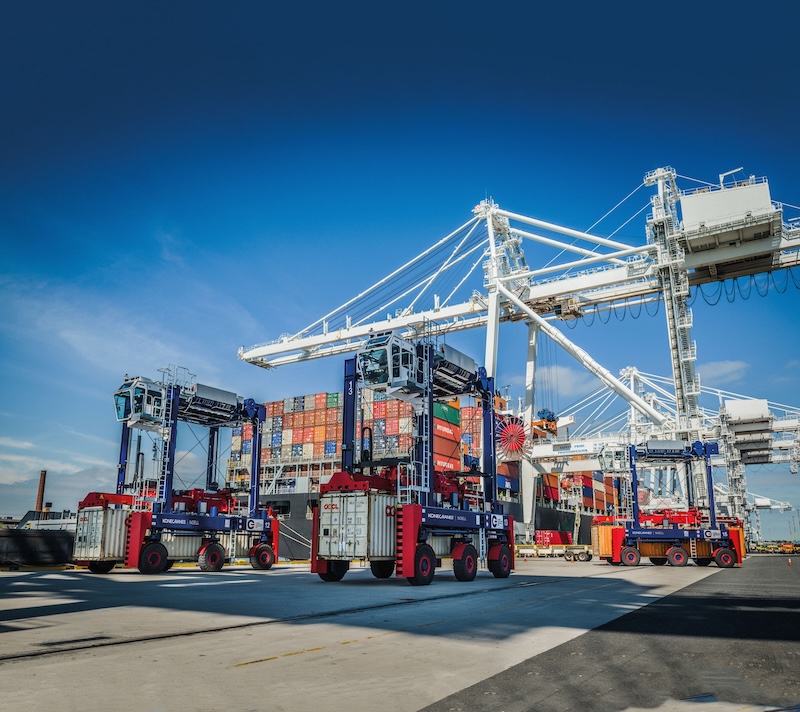
Straddle carriers are among the most recognisable machines in a container yard. Tall, mobile, and capable of lifting containers while moving, they act as the connective tissue between quay cranes and storage areas.
Automation of straddle carriers has been one of the most consequential shifts in terminal operations. Autonomous versions rely on a combination of GNSS positioning, LiDAR, obstacle detection, and centralised fleet management systems. Rather than following rigid tracks, they navigate dynamically within mapped zones, responding to congestion and task priorities.
Suppliers such as Kalmar and Konecranes have deployed autonomous straddle systems at scale, demonstrating improved consistency, reduced accident risk, and predictable throughput.
However, these systems are not universally applicable. Weather, mixed traffic, and irregular terminal layouts can limit performance. Most deployments still rely on human oversight, particularly during abnormal conditions.
Automated cranes: Precision before autonomy
Cranes were automated earlier than vehicles for a simple reason: their operating environment is more structured. Ship-to-shore quay cranes move along fixed rails, handling containers in predictable patterns. Yard cranes operate within defined stacks.
Automation here focuses on precision and repeatability. Anti-sway systems, machine vision, and automated positioning allow cranes to complete cycles with minimal human intervention. In many terminals, crane operators now work remotely from control rooms, overseeing multiple machines simultaneously.
This transition has delivered measurable benefits:
- Improved safety by removing operators from hazardous heights
- Higher consistency in cycle times
- Easier integration with terminal scheduling software
Yet even the most advanced cranes are rarely “lights-out.” Human intervention remains essential for exceptions, maintenance, and coordination with vessels and vehicles.
Internal terminal vehicles: Autonomy under load
Internal terminal vehicles (ITVs) move containers horizontally across terminals, linking cranes, stacks, and transfer points. These machines resemble industrial AGVs but operate under far harsher conditions.
Unlike factory floors, ports present uneven surfaces, dynamic obstacles, and heavy loads that can exceed 40 tonnes. Autonomous ITVs must integrate tightly with crane schedules while avoiding bottlenecks and collisions.
Some systems rely on fixed routes and transponders, while others use free-navigation approaches similar to autonomous mobile robots. Both have trade-offs. Fixed systems offer predictability; flexible systems handle variability better but require more complex sensing and control.
In practice, autonomy in ports remains conservative. Vehicles operate within geofenced zones, with strict speed limits and continuous supervision.
The software layer: Terminals as orchestration problems
Hardware alone does not make a port automated. The true intelligence of a terminal resides in its software.
Terminal Operating Systems (TOS) act as the central nervous system, coordinating cranes, vehicles, gates, and storage areas. These platforms optimise task allocation, sequence container moves, and balance throughput against congestion.
Advanced systems incorporate predictive analytics, using historical data to anticipate peaks, maintenance needs, and failure points. AI plays a growing role, not in replacing operators, but in supporting decision-making under complexity.
Interoperability remains a challenge. Many terminals operate equipment from multiple suppliers, requiring careful integration to avoid fragmentation.
Safety, labour, and political reality
Automation in ports is inseparable from labour and politics. Removing humans from hazardous zones has improved safety records, but it has also triggered resistance from unions concerned about job displacement.
In the US, these tensions are particularly acute. Ports are major employers, and automation decisions are scrutinised at municipal, state, and federal levels. As a result, US terminals have often adopted automation more cautiously than their counterparts in Asia and Europe.
Yet labour shortages are reshaping the debate. As experienced operators retire and fewer workers enter the sector, automation is increasingly framed as a way to sustain operations rather than eliminate jobs.
Case studies: Automation at scale
Highly automated terminals offer insight into what works – and what does not.
Yangshan Port operates one of the world’s most automated container terminals, with minimal on-site labour and extensive use of autonomous vehicles and cranes. Its success reflects long-term planning, centralised governance, and scale.
The Port of Rotterdam, by contrast, demonstrates a hybrid approach, integrating automation within a complex, multi-operator environment. Its experience highlights the importance of flexibility and incremental deployment.
Both cases underscore a common lesson: automation must align with operational reality, not abstract efficiency targets.
Ranked list: Leading port-automation suppliers
Based on deployment depth, system breadth, and operational maturity, the following companies currently shape global port automation:
- Kalmar – End-to-end terminal automation, strong straddle carrier portfolio
- Konecranes – Deep expertise in automated cranes and yard systems
- ABB – Electrification, motion control, and crane automation
- ZPMC – Dominant crane supplier with growing automation capability
- Siemens – Industrial software, electrification, and orchestration platforms
- Liebherr – High-performance cranes with increasing automation features
- TMEIC – Power electronics and crane drive systems
- Navis (Kaleris) – Terminal Operating Systems and optimisation software
Ranking reflects system integration capability rather than component excellence alone.
Economics: Where automation pays off
Port automation demands significant capital investment. The returns come not from labour savings alone, but from:
- Throughput stability
- Reduced accident risk
- Predictable operating costs
Mega-ports with high, steady volumes benefit most. Smaller ports face longer payback periods and greater risk if traffic patterns change.
For US policymakers, this raises a strategic question: whether ports should be treated as market-driven assets or national infrastructure deserving coordinated investment.
What ports teach the robotics industry
Ports illustrate what large-scale robotics really looks like:
- Partial autonomy, not perfection
- Human oversight embedded in the system
- Integration as the primary challenge
Lessons from ports increasingly influence other sectors, from airports to mining and inland logistics hubs.
Autonomy in trade, quietly under way
Automation in ports does not arrive with fanfare. It advances incrementally, shaped by economics, labour, and infrastructure constraints. Yet its impact on global trade is profound.
As the US and other nations rethink supply-chain resilience, ports stand as proof that robotics already underpins the physical economy. Not as a future promise, but as working infrastructure – quietly moving the world’s goods, one container at a time.
