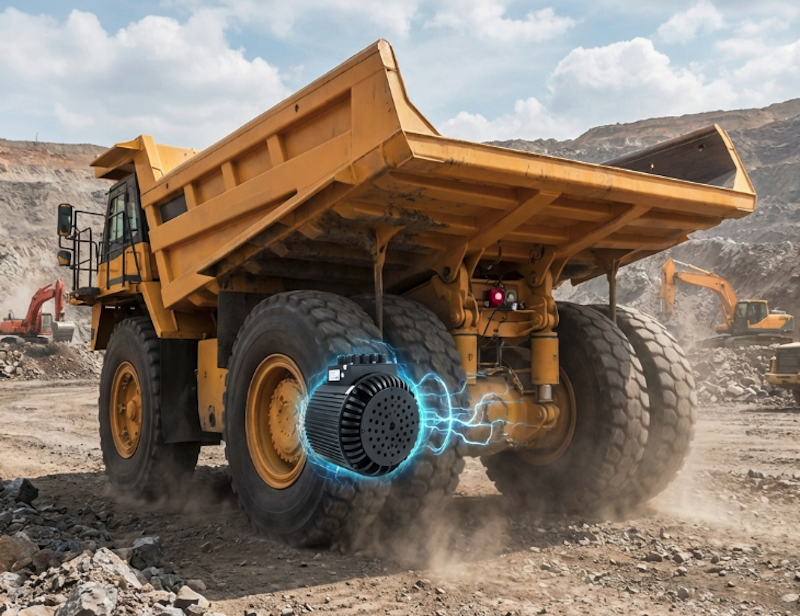
In the realm of electric drive systems, the performance of EV-grade BLDC electric motors has become a defining factor in the transition to electrified heavy-duty industrial vehicles.
These brushless DC (BLDC) motors were originally developed for stringent automotive requirements but now power a wide range of industrial applications that demand reliability, high torque and energy efficiency.
From electric forklifts and haul trucks to autonomous guided vehicles (AGVs) and heavy-duty mobile machines, EV-grade BLDC motors are increasingly recognized for their ability to meet tough operational demands.
When EV-Grade BLDC Motors Become a Requirement
In practice, EV-grade BLDC motors become a requirement when automated industrial vehicles operate continuously under variable load conditions.
Applications such as AGVs, automated material handling systems, and mobile robots often involve frequent start-stop cycles, sustained high load, and exposure to vibration or thermal stress that exceed the design assumptions of a standard BLDC motor intended for intermittent operation.
In many AGV and mobile robot deployments, industrial BLDC motors commonly operate at 60-80% load for more than 16 hours per day, with repeated acceleration and deceleration events occurring every few minutes.
Under these duty profiles, motors intended for intermittent or lightly loaded operation tend to suffer from accelerated thermal aging and reduced control stability, whereas EV-grade designs are better suited to maintain consistent performance over time.
Field Case Study: BLDC Motor Performance
In many AGV and material handling applications, standard industrial BLDC motors appear adequate during initial commissioning.
However, after 3-6 months of continuous operation at 70-80% load with frequent acceleration and deceleration, thermal stress often leads to rising winding temperatures, increased controller derating, and inconsistent vehicle performance.
These effects typically result from insufficient continuous thermal margin rather than immediate motor failure.
Why EV Grade BLDC Motors Work in Tough Conditions?
Not every motor handles stress well, yet EV-inspired electric brushless motor designs stand out by staying strong when used in hard conditions. Power comes quick, runs smooth, even when demands shift without warning.
Built small but tough, they fit tight spaces while delivering force where it matters most. Efficiency stays high, not just at start-up but through long stretches of grinding work.
These traits, first proven on wheels, now prove useful far beyond roads. Machines in factories begin relying on them more, especially where heat, vibration and constant motion is a huge obstacle for engineers to tackle.
High Torque and Power Density
What stands out about high torque BLDC motors is how much twisting force they deliver relative to their compact size. Over on the EV-grade BLDC motors section, you see units showing power levels between 3 kW and 20 kW – each built to produce strong rotational effort.
Take the 20 kW version: it delivers close to 80 N·m of steady torque, a performance level commonly associated with outrunner BLDC motor configurations used in heavy load transport.
These intense performance levels matter most in work machines that haul weight, pick up speed fast or push through shifting drag.
Efficient Operation for Extended Duty Cycles
Heavy-duty industrial vehicles often rely on industrial BLDC motors that operate for long hours with little downtime. In these contexts, efficiency is not just a performance metric – it directly impacts operational costs and system longevity.
EV-grade BLDC motors are known for efficiency figures often exceeding 90%, which help reduce energy consumption and heat generation. Lower wasted energy means batteries or power supplies can last longer between charges or refuels, keeping industrial workflows uninterrupted.
Strong cooling and heat control
Long hours of tough work push the machines to its limit, often raising heat levels. Because of this, EV-style BLDC motors now include smarter ways to stay cool, like airflow or liquid-based methods. When demand stays high, these setups keep output steady without faltering.
Liquid-cooled versions, found more in 10 kW and 20 kW types, manage heat well, supporting durability across grueling shifts in machinery. Temperature control becomes a quiet anchor behind lasting function under pressure.
From a thermal design perspective, EV-grade BLDC motors are typically engineered with higher continuous temperature tolerance and greater thermal margin.
In real deployments, maintaining winding temperatures at least 20-30°C below maximum rated limits during continuous operation significantly improves motor lifespan and performance stability.
This thermal buffer becomes especially important in enclosed or poorly ventilated environments commonly found in automated vehicles.
Thermal limits must be evaluated alongside BLDC motor control strategies to ensure stable operation over extended duty cycles.
In practice, EV-grade BLDC motors in the 10 kW class with liquid cooling are often selected for automated vehicles operating under sustained load, where thermal stability and continuous performance are critical design requirements.
System-Level Design Considerations
EV-grade BLDC motors achieve their performance advantages through tight alignment between motor design, brushless motor controller, control strategy, and power electronics.
Brushless construction reduces mechanical wear, while electronic commutation enables precise torque control under dynamic loads – both critical for automated industrial vehicles operating continuously.
A common mistake in industrial vehicle design is selecting motors based solely on peak power ratings rather than real duty cycles.
In heavy-duty automated applications, frequent acceleration, deceleration, and load variation place far greater stress on the motor than steady-state operation.
EV-grade BLDC motors are designed to tolerate these conditions, but only when thermal limits and control strategies are correctly defined. Projects that overlook this system-level alignment often encounter unexpected downtime despite using high-performance components.
Real-World Applications in Heavy-Duty Automated Environments
From farms to mines, electric-powered machines rely on BLDC motors built for heavy-duty work. Factories and freight hubs use them because they handle tough conditions without failing.
Even building sites depend on their steady performance under pressure. These motors keep running where others would quit. Rugged design makes all the difference when dust, heat or vibration piles up.
Electric forklifts material handlers
Busy warehouses need forklifts that lift steadily while moving smoothly. Thanks to strong, steady force from BLDC motors, shifts between fast and slow happen without interruption. These motors deliver what machines require – especially during constant speed changes.
Autonomous Guided Vehicles (AGVs)
Smooth movement across fixed routes? That comes from accurate drive setups inside automated guided vehicles. Power delivered steadily, thanks to a sensored brushless motor, supports reliable operation day after day, especially during frequent start-stop cycles.
Strong turning force, paired with smart energy use, keeps these machines moving without sudden drops in power. Long shifts run easier when motor efficiency matches real-world demands. Consistent battery behavior emerges naturally under such balanced loads.
Heavy Load Transporters and Mobile Robots
Most factory bots that shift goods, stack crates or fit parts need small but strong drives. Motors borrowed from electric vehicles – lightweight yet punchy – help engineers pack more power into tight spaces.
These brushless units deliver hefty output while keeping bulk and consume less power. Machines grow stronger, not larger, thanks to their lean design. Efficiency climbs when power fits neatly inside narrow frames. Space stays free for other tasks, not wasted on clunky hardware.
Mobile Construction Equipment
On job sites, portable electric machines like mini diggers, haulers or pull carts run well on tough BLDC motors built like those in cars. Though dust flies, ground shifts or heat builds – these drives keep going without faltering.
Challenges and Considerations
Integrating EV-grade BLDC electric motors into heavy-duty automated industrial vehicles requires careful system-level planning.
While these motors offer clear performance advantages, stable power delivery, controller compatibility, and thermal management must be properly engineered to handle dynamic loads.
Industrial environments often involve vibration, temperature variation, and fluctuating energy demand, all of which place additional stress on the drive system.
Inadequate power electronics or poorly matched control strategies can negate efficiency gains and lead to unstable operation over time.
As a result, successful deployment depends not only on motor selection, but on how well the entire drive system is designed, validated, and aligned with real operating conditions.
The Future of BLDC Motors in Industrial Mobility
The electrification of heavy-duty industrial vehicles is accelerating as companies seek cleaner, quieter and more cost-effective solutions.
EV-grade BLDC motors originally developed for automotive performance are well-positioned to lead this transition. Their high torque, efficiency, durability and advanced control capabilities make them a compelling choice for future industrial vehicle design.
As electric power electronics continue to advance and battery technology evolves, BLDC motors will likely remain at the forefront of industrial mobility.
Engineers and designers can leverage this technology to create machines that are not only powerful but also intelligent, adaptable and long-lasting.
Conclusion
Based on these system-level requirements, EV-grade BLDC motors have become a foundational technology for heavy-duty industrial electrification.
Brushless Inc. focuses on applying EV-proven motor design principles to industrial platforms where continuous performance, thermal stability, and long-term reliability are critical.
