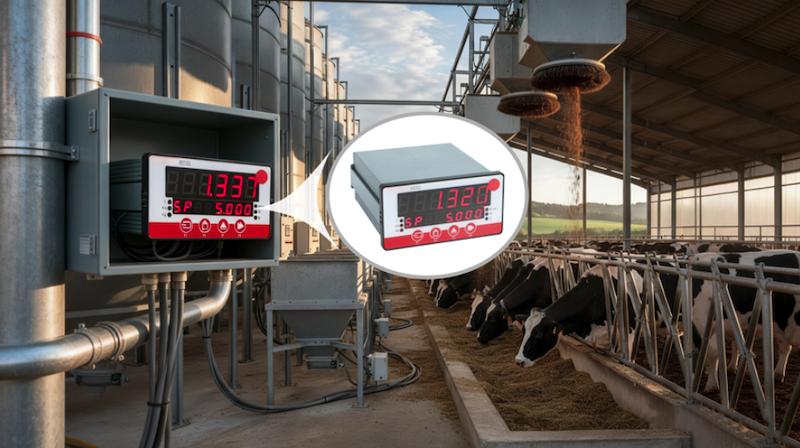
In large livestock operations, precision feed management starts with one simple requirement: knowing exactly how much feed is moving through the system.
That is why load cells sit at the center of modern feeding technology. They provide the hard weight data that AI software and robotic feeders depend on to make real decisions.
Mounted under silos, hoppers, and automated dispensers, load cells measure feed depletion in real time. Every kilogram leaving the system is recorded.
That accuracy allows farms to tighten rations, reduce waste, and respond quickly when something goes wrong. Without load cells acting as the ground truth, feeding systems fall back on estimates, and that is where inefficiency creeps back in.
Load Cell Hardware Basics
Everything begins with the hardware. Most livestock feed systems use strain-gauge load cells, typically compression or S-beam designs. Capacity ranges vary widely, from 500 kg units under small hoppers to 10-ton or higher cells supporting large silos.
Because barns are harsh environments, these load cells must be sealed and rugged. IP68-rated stainless-steel housings are common, designed to handle dust, moisture, and ammonia-heavy air. Silage acids and washdown chemicals destroy unprotected steel quickly, so corrosion resistance is not optional.
A typical installation places four load cells under a feed bin or platform. The cells are wired to a junction box where signals are summed and corner loading is balanced.
The base is leveled using shims, mounting bolts are torqued to specification, usually in the 50 to 100 Nm range, and shielded cable is run back to the control panel to avoid electrical noise from motors and augers.
In a large dairy operation with 5,000 animals, a main feed silo might use industrial weighing modules rated at 0.05 percent of full scale. On a 20-ton silo, that means changes of around 10 kg can be detected reliably, which is more than sufficient for consumption tracking and forecasting.
Maintenance is straightforward but important. Most farms zero the system monthly with the bin empty and check for drift caused by temperature swings. Cells with built-in temperature compensation help, but harsh conditions still take their toll.
Technicians generally recommend welded bellows, overtravel protection, and annual replacement of cells on high-traffic dispensers. At $200 to $500 per cell, this preventive approach is far cheaper than chasing bad data.
Sensor Deployment Across the Feed System
Load cells are placed anywhere the feed changes hands. Under silos, they measure total inventory and withdrawal rates. Hopper bins feeding mixers or robotic systems track batch weights. On automated dispensers, load cells confirm that commanded feed amounts are actually delivered.
In silos, weight readings are typically transmitted every few seconds via 4–20 mA loops or digital protocols like RS485 into a PLC. Mixer hoppers use three or four cells to record ingredient loads, such as silage at a known dry matter percentage or concentrates added by weight before discharge.
Robotic dispensers take this a step further. Systems like rail-mounted feed robots embed load cells directly in the dispensing head or chute. The controller compares target weight to actual delivery and corrects in real time if feed flow changes due to moisture, bridging, or wear.
Accuracy at this level matters. A 0.1 percent error on a 500 kg hopper still gives 500 grams of resolution. That is enough to detect clogged valves, partial unloads, or mechanical wear before animals are affected.
Environmental protection is handled with stainless enclosures, raised mounting to avoid splash zones, and breathers or desiccants in areas prone to condensation. In high-humidity swine barns, heat tracing is sometimes added to prevent icing during winter fills.
Data Flow From Load Cell to AI System
Load cell data starts as a small electrical signal. Strain on the gauge changes resistance in a Wheatstone bridge, producing a millivolt output proportional to weight. That signal is amplified and converted to 4–20 mA or digital data.
Gateways translate the signal into industrial protocols like Modbus or Ethernet/IP. Each weight change is timestamped, allowing the system to calculate feed depletion over time. For example, a silo might show a 2,450 kg drop over 24 hours serving 1,200 animals.
This data is combined with other inputs such as RFID animal identification and temperature sensors. Edge controllers clean the data by filtering vibration spikes from loader trucks and removing baseline drift. What reaches the AI model is not estimated usage, but measured weight loss, often logged at one sample per second.
Edge processing keeps response times short. While long-term trends may be stored in the cloud, live dosing decisions happen locally with latency well under a second.
Predictive Feed Forecasting Using Load Cell Data
Forecasting becomes practical when it is built on accurate weight data. AI models analyze time-series data directly from silo and hopper load cells, looking at hourly and daily consumption patterns.
In dairy operations, steady daily usage might sit around 1,200 kg. When barn temperatures climb above 25°C, load cell data often shows a clear dip in intake. Models trained on several months of data learn to associate these patterns with environmental conditions.
Seasonal shifts also become obvious. Winter consumption may rise by 20 percent due to higher energy needs, while summer patterns shift toward cooler feeding hours. Because the data comes from actual weight loss, the model’s error rates drop sharply compared to visual estimates or schedule-based tracking.
Anomalies stand out immediately. A sudden 30 percent drop in hopper depletion often points to health issues, water supply problems, or mechanical faults. Farms using high-resolution load cell data routinely reduce forecasting error from around 8 percent down to 3 percent.
Operationally, many farms run forecasting scripts overnight on small edge computers. These generate updated refill schedules based on actual curves, not calendars. One Midwest hog operation cut feed deliveries by 22 tons per month simply by timing orders to real consumption data.
Neural Networks for Dynamic Meal Scheduling
Dynamic feeding only works when decisions are based on measured intake, not assumptions. Neural networks in modern feeding systems rely heavily on load cell data for this reason.
Inputs typically include current hopper residuals, 24-hour intake history per animal group, growth curve data from periodic weigh-ins, and barn temperature and humidity. The network processes this data and outputs meal size, timing, and frequency.
In a finisher barn with 500 pigs across 20 pens, load cells under each trough record leftover feed after every meal. If one group consistently leaves 2 kg uneaten, the system trims the next portion and shifts timing slightly earlier to better match feeding behavior.
These decisions are executed through standard industrial communication. The controller sends commands such as “dispense 48 kg to pen 7 at 14:15,” and load cells confirm execution.
Because the system logs cause-and-effect relationships, technicians can trace decisions back to specific residual weights rather than trusting a black box.
Combining Vision Systems With Load Cells
Cameras are useful, but they cannot replace weight measurement. Vision systems identify animals and estimate presence, but they struggle with occlusion, dirt, and similar-looking animals.
Load cells close that gap. Cameras identify which animal or group is present. Load cells verify how much feed is delivered and how much is actually eaten.
A practical sequence looks like this: an RFID tag identifies the animal, a camera confirms position, feed is dispensed, and the load cell measures before-and-after weights. Any uneaten feed is logged and factored into the next cycle.
In trials with sheep and pigs, vision-only systems overestimated intake by as much as 8 percent. When load cell confirmation was added, waste dropped to around 3 percent because top-ups were issued only when real shortfalls were measured.
Robotic Feeders Controlled by Load Cells
Robotic feeders depend on load cells to maintain control. Rail-mounted systems in dairy barns use feedback loops where auger speed is adjusted based on load cell error. If the system targets 25 kg per row and detects a 500 g deviation, it slows or speeds the auger accordingly.
PID control loops keep dispense rates stable, while safety logic halts feeding if residuals exceed defined limits. Load cells also detect clogs when expected weight changes do not occur, triggering automatic purge routines.
Case Study: Load Cells in a Large Swine Operation
A 12,000-head finisher operation in Iowa upgraded its feeding system in 2024. Before the upgrade, feed levels were checked manually and waste was estimated at around 18 percent.
After installing load cells under troughs, adding RFID panels, and deploying edge AI controllers, measurable changes appeared within weeks. Average intake stabilized at 2.6 kg per head, while leftover feed dropped from 0.9 kg to 0.4 kg.
Overfills were reduced by 22 percent, saving roughly $52 per animal annually. Feed conversion improved by 0.15 points, and the system paid for itself in about 18 months. Operators now use load cell logs to investigate health issues instead of guessing.
Environmental and Maintenance Realities
Barn environments are tough on equipment. Ammonia corrodes metal, rodents chew cables, and temperature swings cause drift. Proper conduit, rodent-proof enclosures, and self-draining mounts are essential.
Calibration checks are typically done quarterly using known test weights. Any drift beyond 0.1 percent triggers replacement. Most farms budget a few hours per week for inspection, a small cost compared to feed losses.
Scaling Load Cell Systems Across a Farm
Successful farms start small. One barn, one feeding line, and clear performance targets. Once savings are proven, the system is expanded.
Most follow a phased approach: sensors first, AI models second, robotics last. Open communication protocols make integration easier, and staff training focuses on reading logs and checking zero points.
The result is consistent. Farms that commit to accurate measurement routinely cut feed waste by 15 to 20 percent. It all begins with that first reliable kilogram reading.
