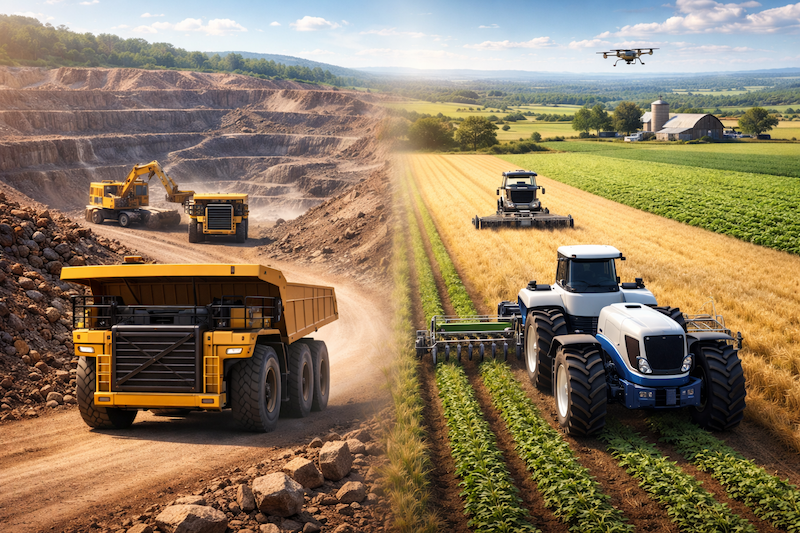
Heavy-duty autonomy in controlled, off-road environments delivers efficiency and safety gains
Autonomous vehicles are still most commonly associated with passenger cars and urban roads. Yet the most mature, commercially proven forms of vehicle autonomy have emerged far from city streets.
They operate in open-pit mines, on remote haul roads, and across agricultural fields – environments where routes are known, traffic is controlled, and the economics of automation are clear.
Mining and agriculture have quietly become the longest-running success stories in vehicle autonomy. These sectors demonstrate what autonomy looks like when expectations are pragmatic, deployment is incremental, and safety and productivity are the primary objectives.
Why off-road autonomy came first
The early success of autonomy in mining and agriculture is not accidental. These industries share structural characteristics that favour automation:
- Vehicles operate on private land, outside public road networks
- Routes are repetitive and predictable
- Operating speeds are relatively low
- Human exposure to hazardous conditions is a major concern
- Productivity gains are easy to measure
Unlike passenger vehicles, autonomous mining and agricultural systems do not need to solve the full complexity of mixed urban traffic. They are engineered to work within constrained operational design domains – and that constraint is precisely what makes them reliable.
Mining autonomy: Industrial scale, proven economics
Mining remains the clearest example of large-scale autonomous vehicle deployment. Autonomous haul trucks have been operating in commercial mines for more than a decade, moving material continuously with minimal human intervention.
Vehicle classes commonly automated include:
- Ultra-class haul trucks
- Drilling and blasting rigs
- Loaders and auxiliary support vehicles
The business drivers are straightforward. Mining operations are often remote, labour is scarce, and safety risks are significant. Autonomous vehicles reduce human exposure to dust, heat, noise, and heavy machinery while improving asset utilisation through continuous operation.
Among the most prominent suppliers is Komatsu, whose Autonomous Haulage System (AHS) has been deployed at mines across Australia, North America, and South America. Komatsu’s autonomous trucks – some of the largest vehicles ever built – operate around the clock with centrally managed fleet control.
Other major players include Caterpillar, which has steadily expanded its autonomous mining portfolio, and mining operators such as Rio Tinto and BHP, both of which have integrated autonomy into their operations to improve safety and throughput.
From an investment perspective, mining autonomy is not speculative. It is a well-established capital equipment market embedded within existing OEM and operator relationships.
Safety before efficiency
In mining, autonomy is often justified on safety grounds before productivity gains are even considered. Removing human drivers from haul trucks eliminates exposure to rollover risks, collisions, and fatigue-related incidents.
Mines also function as closed systems. Traffic rules, vehicle interactions, and operating procedures can be strictly enforced, allowing autonomous systems to behave deterministically rather than reactively. This is fundamentally different from public-road autonomy, where uncertainty is unavoidable.
Efficiency improvements follow naturally: autonomous trucks maintain consistent speeds, reduce idle time, and operate continuously without shift changes.
Agricultural autonomy: Precision over scale
Agriculture presents a different autonomy profile. While the vehicles are smaller and the operating environment less extreme, the logic of automation is similarly grounded in predictability and control.
Autonomous systems in agriculture are most commonly applied to:
- Tractors and tillage equipment
- Seeding and spraying platforms
- Harvesting machinery
Here, the primary objective is precision rather than raw scale. Autonomous vehicles enable more accurate planting, targeted spraying, reduced soil compaction, and better resource utilisation.
Established equipment manufacturers have led much of this transition. John Deere has steadily integrated autonomy and advanced driver-assistance features into its machinery, positioning automation as an extension of existing farming workflows rather than a disruptive replacement.
Other major contributors include CNH Industrial and AGCO, alongside technology suppliers such as Trimble, whose positioning and guidance systems underpin many autonomous and semi-autonomous deployments.
Labour dynamics and seasonal constraints
Labour availability has become an increasingly important factor in agricultural autonomy. Seasonal peaks in planting and harvesting place pressure on farms to complete work within narrow time windows.
Autonomous and semi-autonomous systems help address this constraint by extending operating hours and reducing reliance on scarce skilled operators.
Rather than eliminating jobs, autonomy in agriculture tends to reshape roles, shifting human labour toward supervision, maintenance, and decision-making tasks.
Economics and investor perspective
Unlike consumer autonomous vehicles, mining and agricultural autonomy fits neatly into traditional industrial investment frameworks. These systems are:
- Capital-intensive but durable
- Integrated into existing OEM portfolios
- Purchased by operators with long planning horizons
- Justified through clear ROI metrics
Payback periods are typically shorter than for on-road autonomous vehicles, and deployment risk is lower due to controlled operating conditions. For investors, this makes off-road autonomy more comparable to factory automation than venture-scale technology bets.
The sector’s maturity also explains why it attracts less media attention. Much of the value has already been captured by incumbent manufacturers rather than standalone startups.
Technology stack: Reliability over novelty
The technology behind off-road autonomous vehicles is sophisticated but conservative by design. Common components include:
- GNSS and RTK positioning systems
- LiDAR and radar, used selectively
- Vision systems for object detection
- Fleet management and scheduling software
Compared with urban autonomous vehicles, there is less emphasis on edge-case perception and more focus on reliability, uptime, and system redundancy. Deterministic behaviour is preferred over adaptive experimentation.
Regulation without politics
Another advantage of off-road autonomy is regulatory simplicity. Mining and agricultural vehicles typically operate on private land, governed by corporate safety standards rather than public traffic laws.
As a result, deployment decisions are made in boardrooms rather than legislatures. Safety cases are evaluated internally, in partnership with OEMs and insurers, without the need for broad public acceptance.
This governance structure has allowed autonomy to advance steadily without the political friction faced by on-road autonomous vehicles.
Lessons for on-road autonomy
The experience of mining and agriculture offers a clear lesson: autonomy succeeds when environments are constrained, objectives are narrow, and expectations are realistic.
Incremental deployment, rather than sweeping transformation, has proven to be the most effective path. These sectors show what autonomy looks like when it is treated as industrial optimisation, not technological spectacle.
Quiet success in heavy-duty autonomy
Autonomous systems in mining and agriculture may lack the drama of robotaxis, but they represent the most durable and commercially grounded applications of vehicle autonomy to date.
For investors, the sector is largely established rather than emerging. For the automation industry, it offers a blueprint for how autonomy can scale quietly, safely, and profitably when deployed in the right contexts.
Mining and agriculture demonstrate that autonomy does not need public roads to succeed – it needs control, discipline, and a clear business case.
