Lots of modern SUVs have impressive capabilities like – AWD systems, hill descent control, terrain modes, all the electronic wizardry you could want, but after taking one off the road, you soon realize that most of those features are only impressive on paper. In reality, you want your crossover or SUV to be prepared for beating, and that’s a whole different story.
Take that stock vehicle onto a real trail with rocks, mud, or steep inclines and you’ll quickly discover its limitations. Factory all-season tires spin uselessly in mud, stock ground clearance leaves much to be desired, and that plastic skid plate protecting your oil pan is about as useful as a screen door on a submarine. One good trail ride can cost you thousands in repairs or leave you waiting hours for someone to tow you out.
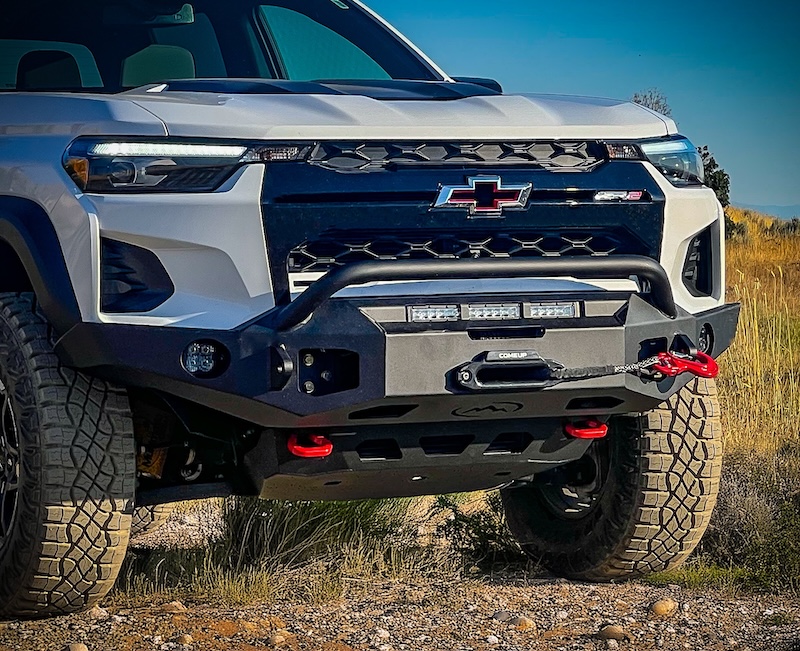
Luckily the aftermarket industry has lots of vehicle-specific options to prepare your rig for off-roading. Whether you need rock sliders for a 3rd gen 4Runner, Outback lift kit or a steel Chevy Trailblazer off road bumper, there are dozens of options to choose from. Although it doesn’t mean you need to invest thousands in your build, if you just want to get out there and explore local trails.
I’ll break down the essential mods every SUV actually needs for starters, ranked by priority and real-world impact. We’ll cover what each upgrade does beyond the marketing hype, and which ones you can skip entirely if the budget is tight.
Wheels
A tire is the only thing on your SUV that actually touches the ground, which makes it the single most important upgrade you can make. Period. I don’t care how much lift you have or how expensive your suspension is – if you’re running factory highway tires designed for fuel economy with low road noise level, you’re going nowhere off-road.
Those stock tires have shallow tread, hard rubber compounds for longevity, and sidewalls that’ll puncture the first time you brush against a sharp rock.
All-Terrain (A/T) tires are what 80% of off-roaders are running because they balance on-road manners with legit traction on a rough terrain. They’ll handle dirt roads and light mud without issue, without drastically affecting your gas mileage on the highway. Brands like BFGoodrich KO2, Falken Wildpeak, and General Grabber are the top options to look at.
Mud-Terrain (M/T) tires are for more dedicated wheelers. With the focus shifted to off-road performance (very impressive in sand/dirt/snow) they do have some disadvantages for pavement use. They’re loud, stiff and overall aggressive. Don’t buy these unless you’re actually wheeling hard regularly.
Pay attention to tread depth, void ratio between lugs for self-cleaning, sidewall strength rated for your terrain, and load rating matching the weight of your SUV.
Cost: $800-1,400 for four quality A/T tires
Suspension
If the ground clearance of your vehicle seems to be too low for the trails you want to conquer, suspension lift should be your main priority in terms of the modifications.
This topic often gets confusing because the market offers three different approaches at how to lift a vehicle, with wildly different price points.
Strut Spacer lifts are the cheapest option at $100-400 – they mount on top of your stock struts and push them down a bit without improving the suspension performance. They let you fit slightly larger tires without rubbing and give a small bump in the ground clearance.
Body lifts are also represented by spacers, but these go between the body of your vehicle and the frame (of course, this doesn’t apply to unibody vehicles that come with an integrated frame). They do nothing to improve the ground clearance, but allow to free up some space in the wheel wells to mount larger tires. Cost $100-400
Complete suspension lifts at $800-3,000+ are the proper solution to improve ground clearance and suspension articulation at the same time. Full coilover systems or matched struts and shocks engineered specifically for lifted applications bring real performance gains with proper damping, wheel travel, and durability.
Most unibody SUVs handle 2-3 inches of lift safely without needing extra mods. Go higher and you’re looking at longer brake lines, CV axle spacers, alignment corrections, and potentially steering geometry issues. Body-on-frame SUVs can handle more lift but still have limits before things get complicated.
Don’t cheap out on shocks even if you’re running a budget spacer lift. Quality shocks absorb trail impacts and maintain control where stock shocks turn your SUV into a pogo stick after the first dozen hits.
Cost: $100-3,000 depending on lift type and installation
Armor
The majority of trucks and SUVs have basically no underbody protection beyond thin plastic splash guards, unless it’s a dedicated trim like a Wrangler Rubicon or a Bronco Sas. Hit a rock with your oil pan, transmission, or fuel tank and you’re done – massive repair bills and a tow truck ride home. One $300 skid plate prevents a $2,000+ oil pan replacement.
Essential protection:
- Engine skid plate: Covers oil pan and front diff, absolute first priority
- Transmission/transfer case skid: Protects drivetrain where clearance is lowest
- Fuel tank skid: Prevents punctures that strand you
- Rock sliders: Guard rocker panels and provide proper jack points
Aluminum skids ($200-400 each) are lightweight and adequate for most trail use. Steel skids ($300-600 each) are heavier but stronger for serious rock crawling. Most SUV owners should run aluminum.
Installation is straightforward – everything bolts to existing frame points. Full coverage protecting engine, trans, and tank runs $800-1,500 installed.
Off-road bumpers replace plastic factory units with steel, add winch mounting and recovery points. Not essential starting out but valuable later. Budget $600-3,000 per bumper.
Cost: $800-2,500 for complete skid coverage; $1,000-3,000+ for bumpers
Recovery
Getting stuck isn’t a question of “if” but rather “when” once you start hitting real trails. Recovery gear gets you out without waiting three hours for a tow truck to find you. At minimum you need recovery straps rated for your vehicle weight (kinetic straps for stuck vehicles, static straps for pulls), proper D-ring shackles that won’t fail under load, and traction boards like Maxtrax for getting unstuck from mud or sand. Add a shovel and you’re ready for a solo adventure out in the wild. A good basic recovery kit runs $300-600. If you’re getting serious about off-roading, a winch is worth the investment too. 8,000 to 12,000 lb is usually enough for most SUVs.
Cost: $300-600 for basic recovery kit; $1,000+ with winch
Build Smart, Not Expensive
Many SUV owners waste money on parts they don’t need while skipping the essentials that actually matter. Start with tires and gradually move on. This upgrade alone will take you further than $5,000 worth of overlandish mods. Add a lift and recovery gear as your budget allows and you’ll have a solid rig for under $3,000 that can handle most trails. Leave the expensive bumpers, winches, and lockers until you’ve actually spent time off-road and know what your specific rig needs based on real experience, not Instagram pics.
