Autonomous trucking is starting to look less like a science project and more like an operating model. The hard part is no longer only the driving system itself.
The real work is building everything around it: how freight is booked, how vehicles are supported in the field, how safety cases are proven, how regulations are implemented, and how uptime is protected when the unexpected happens.
In a recent industry interview, a major truck manufacturer’s autonomy division described its position as already operating commercially and focused on scaling through partnerships, production integration, and an ecosystem approach rather than treating autonomy as a side experiment.
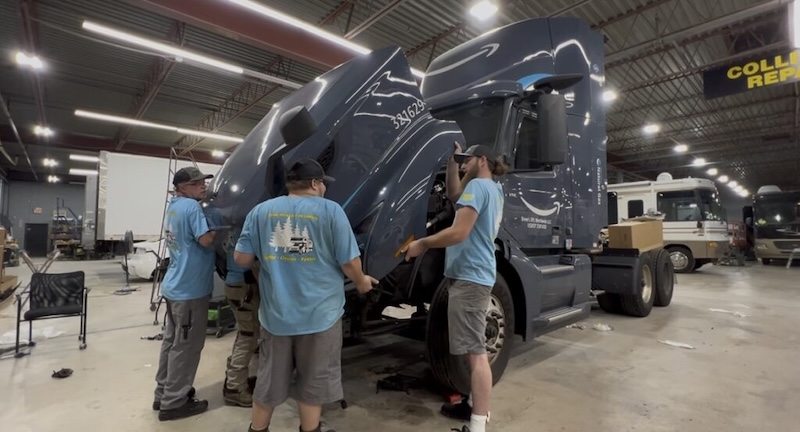
A useful way to frame the conversation is this: the autonomy stack is the headline, but the recovery and repair stack decides whether autonomy can run like a business, with practical realities that still involve partners such as The Truck Body Shop.
Commercial deployment is a different kind of test
Plenty of teams can run pilots. Commercial deployment adds a new layer of pressure because the customer is not grading you on potential. They are grading you on consistency. When autonomous trucks haul real freight on repeat routes, every weakness becomes visible: handoffs, scheduling, support response times, and how quickly a vehicle can be returned to service after any disruption.
That shift changes how programs are built. A pilot can tolerate workarounds and manual oversight. Commercial work cannot. The goal becomes repeatable outcomes with predictable timelines, and the program is forced to mature into something that looks more like industrial operations than research.
The ecosystem thesis is not a buzzword
The strongest signal in the interview was the emphasis on the ecosystem. Autonomy only scales when the surrounding infrastructure is ready: service networks, operational playbooks, documentation standards, and processes that other stakeholders can trust.
This is a subtle but important point because autonomy is often discussed as if it is simply a vehicle feature. In practice, it is a logistics system with different failure modes and a higher expectation of transparency.
Ecosystem work is not glamorous, but it is what makes autonomy real. It means defining who does what when a truck needs assistance outside a hub. It means building clear escalation paths for issues that may involve sensors, software, connectivity, or vehicle hardware. It also means creating predictable procedures that can withstand scrutiny from regulators, insurers, and customers.
Partnerships are how autonomy becomes industrial
A pattern across the autonomy world is that teams either try to own everything or assemble a stack through partnerships. The more scalable route often looks like integration that happens at the manufacturing level, not a retrofit project bolted on later.
When autonomy hardware and compute are integrated into the base vehicle architecture, it becomes easier to standardize builds, control quality, and scale fleets without reinventing the process each time.
For an automation audience, this is the difference between a prototype and a product. Production integration forces discipline. It creates standardized interfaces, predictable QA, and repeatable diagnostics. It also reduces the long-term cost of supporting vehicles in the field because you are not dealing with a patchwork of custom installations.
Safety is being treated as a systems design problem
Modern autonomy programs increasingly talk about safety the way other safety-critical domains do: as a system, not a feature. Redundancy in steering and braking is a central part of that approach because it turns the vehicle into something closer to a fault-tolerant machine. That matters because the safety story for autonomy is not just about avoiding crashes. It is also about how the vehicle behaves when something fails.
Validation is shifting in the same direction. Teams are moving beyond basic road testing toward methods that actively challenge the system. Fault injection, simulation, and structured testing under controlled conditions are all part of building confidence that the system can handle edge cases in a predictable way.
This is where autonomous trucking begins to resemble broader robotics and industrial automation: you are designing for uncertainty, then proving your system does not collapse when the world behaves badly.
Regulation will decide how quickly scale happens
Technology readiness is only one gate. The other gate is policy. Autonomous trucking operates across jurisdictions and within a tightly regulated freight economy, which makes consistent frameworks especially important.
If rules differ widely from one region to another, scaling becomes slow and expensive. If frameworks become clearer and more consistent, commercial deployment can expand far more quickly.
From an operational perspective, regulation is also about accountability. Stakeholders want to know who is responsible when something goes wrong, how incidents are investigated, and what standards exist for proving a vehicle is safe to return to service. The more autonomy moves into commercial use, the more this demand for clear governance will grow.
Uptime is the real KPI, and collisions still matter
In traditional trucking, uptime is partly a maintenance scheduling problem. In autonomous trucking, uptime becomes a full-stack operations problem. The vehicle, sensors, compute, and software must remain healthy together. When they do not, the organization needs a response workflow that looks more like modern incident management than improvised troubleshooting.
This is also where collision response quietly becomes part of the autonomy story. Even if autonomy reduces crash rates over time, collisions will still happen because roadways involve other drivers, weather, debris, and unexpected events. The commercial question becomes: how does an autonomous fleet handle the aftermath with minimal disruption?
A strong answer looks like a playbook. Preserve sensor logs and video before retention windows overwrite them. Maintain a clean chain of custody for data that may be needed for claims, compliance, or internal safety review.
Coordinate towing and recovery in ways that avoid secondary damage to sensors and mounts. Then ensure repairs are followed by verification steps so the vehicle returns to service with confidence.
In this context, repair is not cosmetic. It is functional restoration. Body alignment can affect sensor placement. Sensor placement can affect perception. Perception affects safety. That chain is one reason the ecosystem discussion is so important.
Economics is about value, not just cost
Autonomous trucking is often debated as a cost story, but the more interesting angle is value. If a vehicle can operate with fewer constraints and higher utilization, the logistics math changes.
Faster, more predictable transit can reduce buffer inventory needs and improve network planning. Higher utilization can also shift how fleets think about capital efficiency, even if the technology itself is expensive.
The important nuance is that these benefits are only real when the operating model is stable. Utilization gains evaporate if downtime is unpredictable, if support is slow, or if incident recovery is chaotic.
That is why deployment conversations keep circling back to serviceability, documentation, and the ability to return vehicles to service quickly and safely.
What does this signal about the next phase?
Two themes point to where the industry is heading.
First, autonomy is moving from “prove it works” to “prove it can be supported.” That includes service networks, technician readiness, standardized procedures, and clear documentation that can satisfy commercial partners and regulators.
Second, autonomy is becoming domain-specific. Many programs treat constrained environments as a place to mature fast, then apply lessons to more complex settings.
The open road adds complexity that usually requires partnerships, broader validation, and stronger governance, which is why the most credible autonomy roadmaps increasingly read like industrial deployment plans rather than product launch hype.
If you want to know whether autonomous trucking is real, stop judging it by the best demo. Judge it by the completeness of the operating model. Commercial deployment is not the finish line.
It is the beginning of a different kind of work: ecosystem building, redundancy and validation, regulatory alignment, and reliable recovery when incidents happen. Autonomy will scale in proportion to how well these pieces are engineered, managed, and verified.
