Web applications have become an integral part of how industrial companies track their daily operations. Instead of dealing with service requests alone or routinely tracking supply chains or equipment records, companies rely on management software to take that burden off the staff.
However, industrial web applications are just as vulnerable to cyberattacks as most other apps. A weak login, exposed API, or a broken access rule can all become a quick entry point for an attacker trying to get access to sensitive data.
Add to this the speed at which new updates or features are usually rolled out, and the risk of sensitive data exposure increases tenfold. This is why most industrial companies are turning to AI-powered penetration testing tools, which help speed up security testing and enable teams to hunt for vulnerabilities live.
If you’re looking for an AI pentesting tool and don’t want to spend hours on demo calls just to find out that the tool you picked is not suitable for your situation, you’re in the right place. This article covers the 5 best AI pentesting tools, comparing their capabilities side by side and giving ideal scenarios for the use of each of them.
1. Aikido Attack
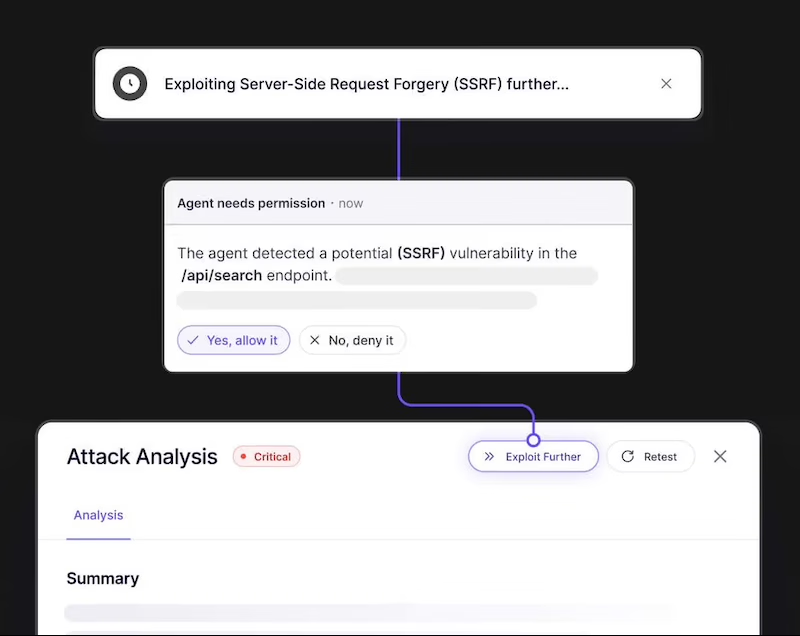
Aikido Pentesting protects industrial web apps by safely validating critical vulnerabilities without crashing fragile physical hardware. By analyzing backend code, its agentic AI uncovers devastating logic flaws – like unauthorized users triggering machinery shutdowns – that standard scanners miss.
For highly regulated or air-gapped factories, Aikido Machine deploys:
- On-premises to secure local HMI dashboards and edge devices without cloud exposure;
- Simultaneously tests mobile field-service apps and connected APIs to block signal tampering;
- Generates audit-ready SOC 2/ISO 27001 reports in hours, allowing industrial vendors to instantly prove supply chain compliance to enterprise buyers.
Best For: Industrial software teams that want to test web applications and APIs while bringing security findings into a broader AppSec workflow.
2. Burp Suite
Burp Suite is the industry-standard toolkit for manual, hands-on penetration testing of industrial web applications and HMI/SCADA interfaces.
Its intercepting proxy allows engineers to precisely inspect and manipulate raw HTTPS and WebSocket traffic, which can help prevent the high-volume automated traffic spikes that are dangerous for sensitive on-premises gateways.
Furthermore, the tool comes with a broad range of custom BApp extensions. For example, by utilizing deep community extensions like Autorize, security teams can hunt for:
- industrial logic flaws;
- session hijacking;
- cross-tenant API vulnerabilities, and more.
On the downside, Burp Suite doesn’t have Aikido’s white-box repository integration, which means the involvement of an expert human operator is required to filter out requests so they can’t harm fragile physical hardware.
Best for: Security teams with experienced testers that need detailed control over web application tests and want to investigate complex findings manually.
3. StackHawk
StackHawk is a specialized Developer-First Dynamic Application Security Testing (DAST) platform. In industrial web applications, it serves a distinctly different role than Aikido or Burp Suite by focusing entirely on preventing vulnerabilities before software ever deploys to physical hardware.
Some of the tool’s highlights include:
- shift-left CI/CD safeguards that prevent any security bugs from reaching sensitive SCADA, HMI, or IIOT environments;
- deep API and Microservice Mastery ensuring data transfers between physical edge sensors and dashboards are fully authenticated;
- Configuration-as-Code Customization.
Where StackHawk falls short is that it does not connect to the backend repository code to map out high-level tenant business logic. This makes it less optimized for finding physical business logic flaws.
Best for: Development teams that want to integrate repeatable web application and API security checks into CI/CD pipelines and catch vulnerabilities before release.
4. Invicti
Invicti provides automated, enterprise-grade DAST/IAST scanning featuring its new Agentic Pentest AI to safely exploit and prove vulnerabilities with zero false positives. It excels at scaling across massive enterprise networks, mapping complex single-page apps, and handling multi-step SSO protocols used to secure critical infrastructure.
However, its native scanning engines are aggressive. In fragile industrial ecosystems, it requires careful throttling configuration to prevent accidental network floods that could crash legacy on-premises PLCs or IIoT gateways.
Best for: It is best suited for large-scale corporate asset management rather than rapid, developer-centric CI/CD workflows.
5. Acunetix
Acunetix delivers ultra-fast automated web and network scanning, featuring an on-premise deployment model that is perfect for air-gapped factories and local HMI dashboards. Its DeepScan engine maps complex JavaScript applications, while its AcuSensor technology provides gray-box insights by pinpointing the exact line of backend code housing a flaw.
Because it excels at navigating complex, multi-step industrial logins via a custom macro recorder, it thoroughly evaluates restricted SCADA environments. However, its default high-speed engine requires tight request-throttling calibration to avoid overwhelming legacy PLCs, and it lacks Aikido’s repository-wide visibility for finding deep business logic flaws.
Best for: Best for industrial IT and security teams that need automated vulnerability scans of web applications and want to check established portals regularly for common security weaknesses.
Final Thoughts
AI-assisted penetration testing can help industrial companies find web application flaws sooner and keep security checks in step with software updates.
Aikido is a strong starting point for teams seeking a broad application security approach, while Burp Suite offers hands-on testing, StackHawk focuses on developer-led DAST, and Invicti and Acunetix support automated scanning.
No single tool catches every vulnerability. The best results come from repeatable tests, well-configured access, skilled review, and a clear process for fixing what testing uncovers.
