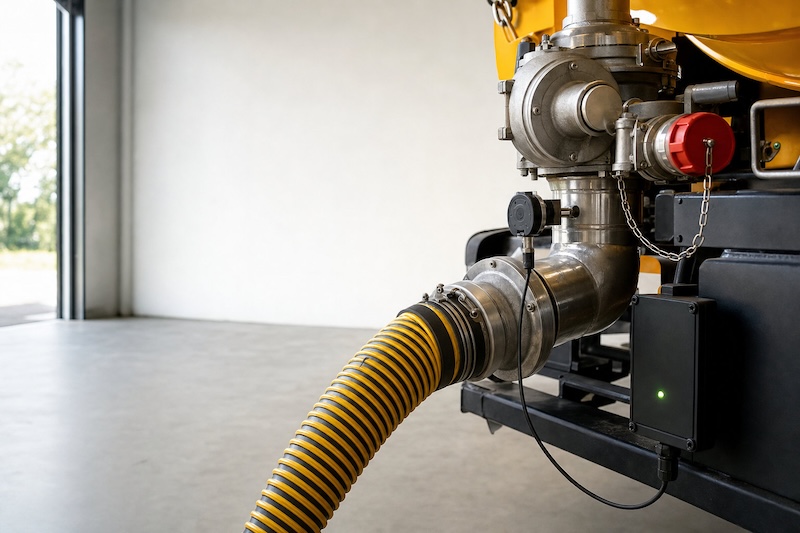
Modern sanitation fleets rely on mechanical engineering advances and automated management to ensure equipment is reliable and efficient.
Predictive maintenance technologies are reshaping how sanitation vehicles are monitored, serviced, and optimized, driving greater uptime and operational efficiency in the field.
Industrial sanitation operations require fleets of mechanically intensive vehicles and specialized equipment to maintain hygiene, manage waste, and fulfill regulatory requirements. The cost of unexpected breakdowns extends beyond repairs.
It affects safety, disrupts route schedules, and reduces service reliability. The Vacuum Truck, for example, is essential for waste transfer and collection, making the reliability of its complex mechanical and hydraulic systems critical to efficient fleet management in automated environments.
Predictive maintenance uses data-driven tools and practices to reduce unplanned downtime and to manage maintenance costs for sanitation equipment.
With real-time condition monitoring, analytics, and automated planning, predictive maintenance integrates performance data into maintenance workflows, aligning with the needs of modern fleet operators seeking proactive, evidence-based asset management.
The essential role of reliability in sanitation fleets
Reliable operation of sanitation fleet assets, such as pumps, vacuum systems, and truck-mounted hydraulic assemblies, is foundational to both service delivery and regulatory compliance.
Unplanned failures can disrupt fleet routes, overload backup resources, and increase the risk of compliance violations – a particular concern for managers overseeing multi-vehicle industrial fleets.
Fleet operators track equipment uptime as a key performance metric, influencing productivity and contract fulfillment. Predictive maintenance technologies support this priority, providing actionable early warnings of component wear or system irregularities.
This capability enables maintenance to shift from reactive response to proactive intervention, a hallmark of effective automation in fleet management.
Beyond operational disruptions, equipment reliability directly impacts workforce safety and environmental protection. Sanitation vehicles operating with degraded hydraulic systems or failing vacuum pumps pose risks of fluid leaks, pressure failures, and potential exposure to hazardous materials.
Predictive maintenance technologies help identify these safety-critical issues before they escalate, enabling maintenance teams to address vulnerabilities during controlled service windows rather than emergency responses.
This proactive approach reduces workplace incidents, minimizes environmental contamination risks, and supports compliance with occupational health and safety standards that govern industrial sanitation operations.
From scheduled servicing to predictive decision making
Conventional maintenance often relies on predefined service intervals, such as odometer readings or equipment run-time hours. While these preventive methods prevent catastrophic failures, they may unnecessarily replace parts or drive up operating expenses.
Condition-based maintenance offers a step forward by using sensor data to trigger servicing only when components reach preset thresholds, optimizing resource allocation.
Predictive maintenance furthers this evolution with real-time data analytics and system-wide integration. By utilizing continuous input from a network of sensors, algorithms can project the likelihood and timing of component failures.
Recommendations for intervention can then be aligned with actual risk levels, improving maintenance scheduling and resource deployment within automated fleet systems.
The transition to predictive maintenance represents a fundamental shift in maintenance philosophy, moving organizations from time-based assumptions to evidence-based decision making.
This evolution requires not only technological investment but also cultural change within maintenance departments. Technicians and fleet managers must develop new competencies in data interpretation, analytics platform navigation, and digital workflow management.
Training programs that bridge traditional mechanical expertise with modern data literacy enable maintenance teams to fully leverage predictive technologies, transforming maintenance from a cost center into a strategic operational advantage that drives competitive differentiation in service delivery.
Critical data signals enable timely maintenance insights
Sanitation vehicles equipped with advanced sensors generate vast data streams. Metrics such as engine temperature, hydraulic pressure, oil condition, electrical load, and vibration patterns are transmitted through telematics to centralized analysis platforms for automated review.
Systematic monitoring of these data enables maintenance teams to identify performance deviations and anticipate potential faults as part of a digital maintenance regime.
Shifts in vibration analytics, as detected by accelerometers, can signal pump misalignment or bearing degradation. Telematics also capture operator behavior and duty cycles, correlating abnormal wear patterns with real-world equipment use.
These high-frequency data signals feed into cloud-based analytics platforms for real-time diagnostics and machine learning, supporting advanced maintenance alerting mechanisms and optimizing portable facility management practices through increased automation.
Advanced vacuum truck technology and systems now enable operators to proactively monitor component health, detect developing issues early, and automate maintenance scheduling to extend service intervals while minimizing unexpected downtime.
Technology stacks powering predictive maintenance systems
Deployment of predictive maintenance starts with edge instrumentation and sensor installations across vehicle subsystems. These ruggedized devices, designed to measure vibration, pressure, fluid levels, electrical parameters, and operational loads, supply continuous real-time diagnostics under the challenging conditions facing sanitation fleets.
Industrial IoT connectivity channels these data streams to central analytical systems or cloud environments, with secure protocols to maintain data integrity.
Edge computation and bandwidth management allow quick response to detected anomalies and ensure maintenance recommendations are delivered with minimal latency, critical in automation-centric operations.
Cloud-based platforms aggregate sensor, maintenance, and usage history data fleet-wide. Fleet managers and maintenance planners gain a unified view through customizable dashboards, enabling coordination of predictive maintenance actions, resource allocation, and service optimization across the operational ecosystem.
Analytics strategies and their practical effectiveness
Basic rules-based methods utilize operational thresholds for monitored parameters (such as pressure or temperature) to generate instant alerts when a limit is breached, providing a straightforward monitoring baseline.
However, such fixed thresholds can either result in false alerts or miss gradually developing faults if not calibrated to match actual equipment behavior.
Anomaly detection enhances monitoring by identifying departures from typical system operation, using historical baseline data and statistical or machine learning algorithms.
Early alerts to subtle deviations enable maintenance to address issues before system-level failures, a significant advantage for larger, automated fleets where oversight must efficiently span many assets.
For more advanced needs, remaining useful life estimation models analyze real-time and historical data to predict when specific components will require servicing.
This supports long-term maintenance scheduling and parts logistics, integrating deeply with automated fleet management strategies.
Integrating predictive insights into daily operations
In practice, predictive maintenance insights are routed directly into fleet management and computerized maintenance management systems (CMMS), streamlining response from fault detection to work order generation.
As predictive models identify emerging issues, actionable alerts specify affected subsystems, task details, and resource requirements.
Integration with ERP solutions automates inventory checks and parts ordering, ensuring that maintenance schedules align with both asset status and spares availability.
Such automation streamlines maintenance event workflow, minimizing operational interruptions and maximizing utilization rates across the sanitation fleet.
Organizations incorporate field data and feedback into maintenance standard operating procedures, benefiting from iterative improvement.
The closed feedback loop between predictive alert data and fleet processes helps build confidence in automation and supports widespread adoption within mechanical engineering teams.
Addressing common failure modes for greater equipment lifespan
Predictive maintenance targets key failure points in sanitation technology, including pump cavitation, hydraulic fluid leaks, bearing deterioration, and valve blockages. By identifying early warning signals, repairs and component replacements can be scheduled before failures occur, reducing costly unplanned downtime in automated fleet operations.
Shifting maintenance from reactive extremes to scheduled interventions improves overall fleet reliability and decreases emergency repair expenses.
Using predictive tools, key fleet performance indicators such as mean time between failures (MTBF) and mean time to repair (MTTR) can be systematically improved, supporting long-term asset value and resilience within smart sanitation infrastructure.
