The packaging industry is undergoing a profound transformation. As consumer demands intensify and production timelines shrink, manufacturers across every sector are turning to smarter, faster, and more efficient solutions.
At the heart of this revolution is VFFS technology, a system that has quietly become one of the most essential tools in modern packaging facilities.
Vertical Form Fill Seal machines have long been a staple on production floors, but the future promises something far more capable, connected, and precise than what the industry has seen before.
Understanding the Role of VFFS in Modern Packaging
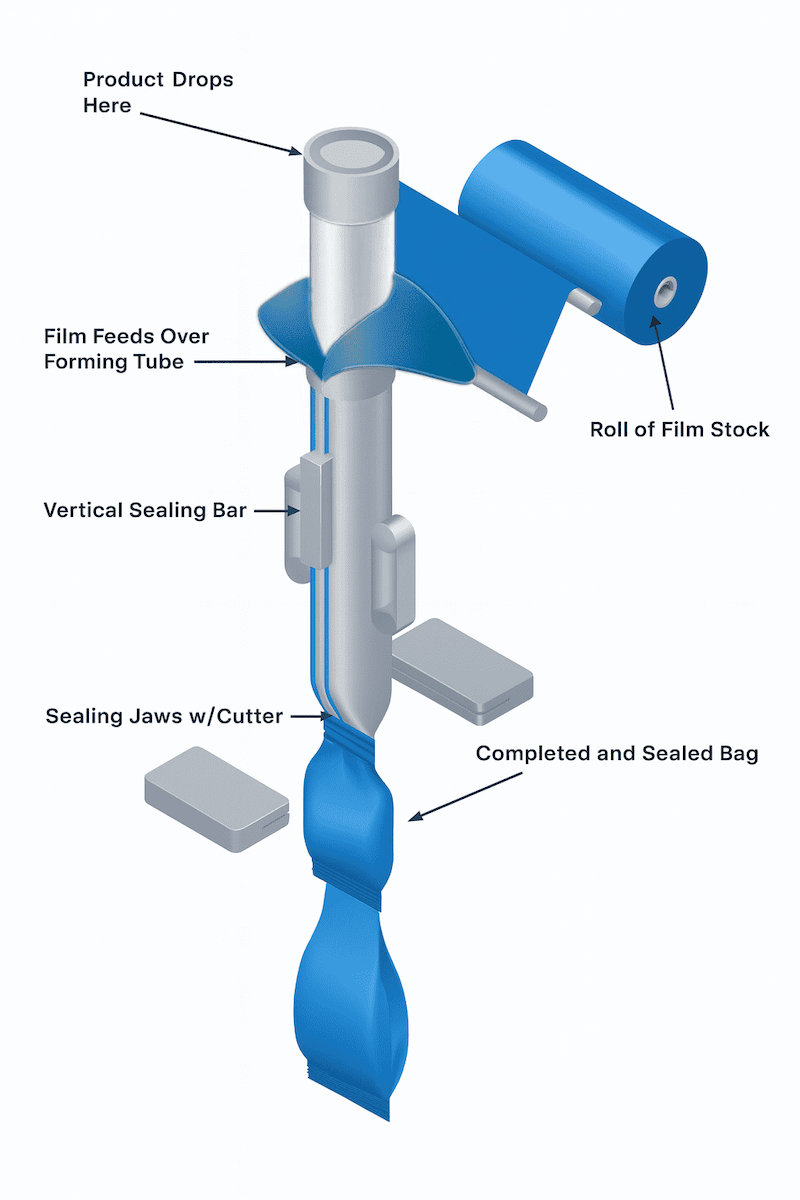
VFFS which stands for Vertical Form Fill Seal is a type of automated packaging system that forms bags from a flat roll of film, fills them with product, and seals them, all in one continuous vertical motion.
These machines are used across a wide range of industries, from food and beverage to pharmaceuticals, pet food, hardware, and beyond. Their appeal lies in their versatility, speed, and relatively compact footprint compared to the volume of product they can process.
For decades, VFFS machines have delivered consistent results in high-volume environments. But as production demands evolve, so too must the machines that serve them.
The next generation of VFFS technology is being shaped by several powerful forces digitalization, sustainability, artificial intelligence, and the push for hygienic design standards. Together, these forces are redefining what it means to run a high-speed packaging operation.
Speed Without Compromise: The New Performance Benchmark
One of the most exciting frontiers in VFFS development is the race toward higher throughput without sacrificing seal integrity or product quality. Traditional VFFS machines operate at impressive speeds, but the modern production environment demands even more.
Manufacturers are now engineering VFFS systems capable of processing hundreds of bags per minute, with precise control over film tension, temperature, and fill weight at every stage.
The challenge has always been maintaining accuracy at speed. When a VFFS machine is running at peak capacity, even a slight deviation in seal temperature or film tracking can lead to defective packaging, wasted product, and costly downtime.
New servo-driven systems are addressing this challenge by providing real-time micro-adjustments that keep every parameter within tight tolerances, regardless of line speed. These advancements are pushing VFFS performance into a new tier of reliability.
Smart Integration: VFFS Meets Industry 4.0
Perhaps the most significant shift in the future of VFFS technology is its integration with Industry 4.0 principles. Smart factories are no longer a futuristic concept they are being built today, and VFFS equipment is becoming a key data node within them.
Modern VFFS machines are increasingly equipped with sensors, PLCs (Programmable Logic Controllers), and IoT connectivity that allow them to communicate directly with plant management systems.
This connectivity enables real-time monitoring of machine performance, predictive maintenance alerts, and remote diagnostics all of which contribute to reduced downtime and improved overall equipment effectiveness (OEE).
Predictive maintenance is particularly transformative for VFFS operations. Rather than scheduling maintenance based on fixed intervals or waiting for a machine to fail, connected VFFS systems can detect early signs of wear or irregularity and alert maintenance teams before a breakdown occurs.
This proactive approach extends machine life, reduces repair costs, and keeps production schedules on track.
Artificial Intelligence and Machine Learning in VFFS Systems
Artificial intelligence is beginning to play a meaningful role in optimizing VFFS performance. Machine learning algorithms can analyze production data collected by VFFS machines over time and identify patterns that human operators might miss. This includes correlations between environmental conditions, film types, product characteristics, and seal quality outcomes.
AI-driven VFFS systems can self-optimize in response to these patterns, automatically adjusting settings to maintain peak performance as conditions change. For example, if humidity in a facility rises and affects film behavior, an AI-enabled VFFS machine can compensate in real time without operator intervention.
This level of autonomous operation is a game-changer for high-speed packaging environments where every second of manual adjustment translates into lost output.
Vision systems powered by AI are also being integrated with VFFS lines to conduct 100% in-line inspection. Every bag that exits the machine can be scanned for seal quality, fill level, label placement, and date coding accuracy catching defects instantly and maintaining compliance standards without slowing production.
Sustainability and the Shift Toward Eco-Friendly VFFS Solutions
Sustainability is no longer an optional consideration in packaging it is a mandate. Consumers, regulators, and brand owners are all applying pressure to reduce plastic waste and environmental impact. VFFS technology is responding to this pressure in meaningful ways.
One major development is the adaptation of VFFS machines to run on sustainable and compostable film materials. Historically, many eco-friendly films were difficult to process at high speeds due to their different tensile properties and heat-sealing requirements.
Newer VFFS designs are being engineered from the ground up to handle these materials efficiently, opening the door for manufacturers to pursue sustainability goals without sacrificing throughput.
Reduced film usage is another area of innovation. Advanced VFFS systems now offer tighter control over bag dimensions, allowing manufacturers to minimize film consumption while still delivering the packaging their products require. Even small reductions in film per bag can translate into significant material savings at scale.
Hygienic Design: Meeting the Demands of Food and Pharma
In food processing and pharmaceutical packaging, hygiene is paramount. The future of VFFS in these sectors is closely tied to advancements in hygienic machine design.
Regulatory standards continue to tighten, and VFFS manufacturers are meeting these standards with equipment that is easier to clean, harder for contaminants to reach, and compliant with international food safety frameworks.
Stainless steel construction, open-frame designs, IP-rated electrical components, and quick-release tooling are becoming standard features on next-generation VFFS machines.
These design choices reduce the risk of contamination and significantly cut down the time required for changeovers and deep cleaning both critical factors in facilities running multiple SKUs or shifting between product types.
Flexibility and Quick Changeovers in a Multi-SKU World
The modern packaging operation is rarely a one-product environment. Brands are launching more SKUs, in more sizes, more frequently than ever before. VFFS machines must keep pace with this demand for flexibility without introducing excessive downtime between format changes.
Future VFFS systems will increasingly feature tool-free changeovers, recipe-driven controls, and modular components that allow operators to switch between bag styles, sizes, and formats in minutes rather than hours.
Touchscreen HMI interfaces with saved product recipes simplify the operator experience and reduce the chance of human error during changeovers. This flexibility makes VFFS technology more valuable across a wider range of packaging scenarios.
The Road Ahead
The future of VFFS technology is one of convergence where speed, intelligence, sustainability, and hygiene come together in a single, highly capable machine.
As digitalization continues to deepen its roots in manufacturing, VFFS systems will become smarter, more self-sufficient, and more deeply integrated into the fabric of connected production environments.
For packaging operations looking to stay competitive, investing in next-generation VFFS technology is not simply about upgrading a machine. It is about future-proofing an entire production philosophy.
The VFFS machines of tomorrow will be dynamic, data-driven partners in efficiency capable of adapting to change, anticipating failure, and delivering consistent quality at speeds that define the new standard in high-performance packaging.
Main image courtesy of Fill-Package.com
